
Picture a packaging factory owner in West Java who abruptly lost a long-term contract with a multinational retail chain this week. The reason for the cancellation was simple yet fatal: the company failed to provide an integrated carbon emission audit certification recently mandated by regulators. The loss of billions in revenue occurred not due to poor product quality, but because of a delayed adaptation in operational systems.
The Shift in Green Regulatory Landscape
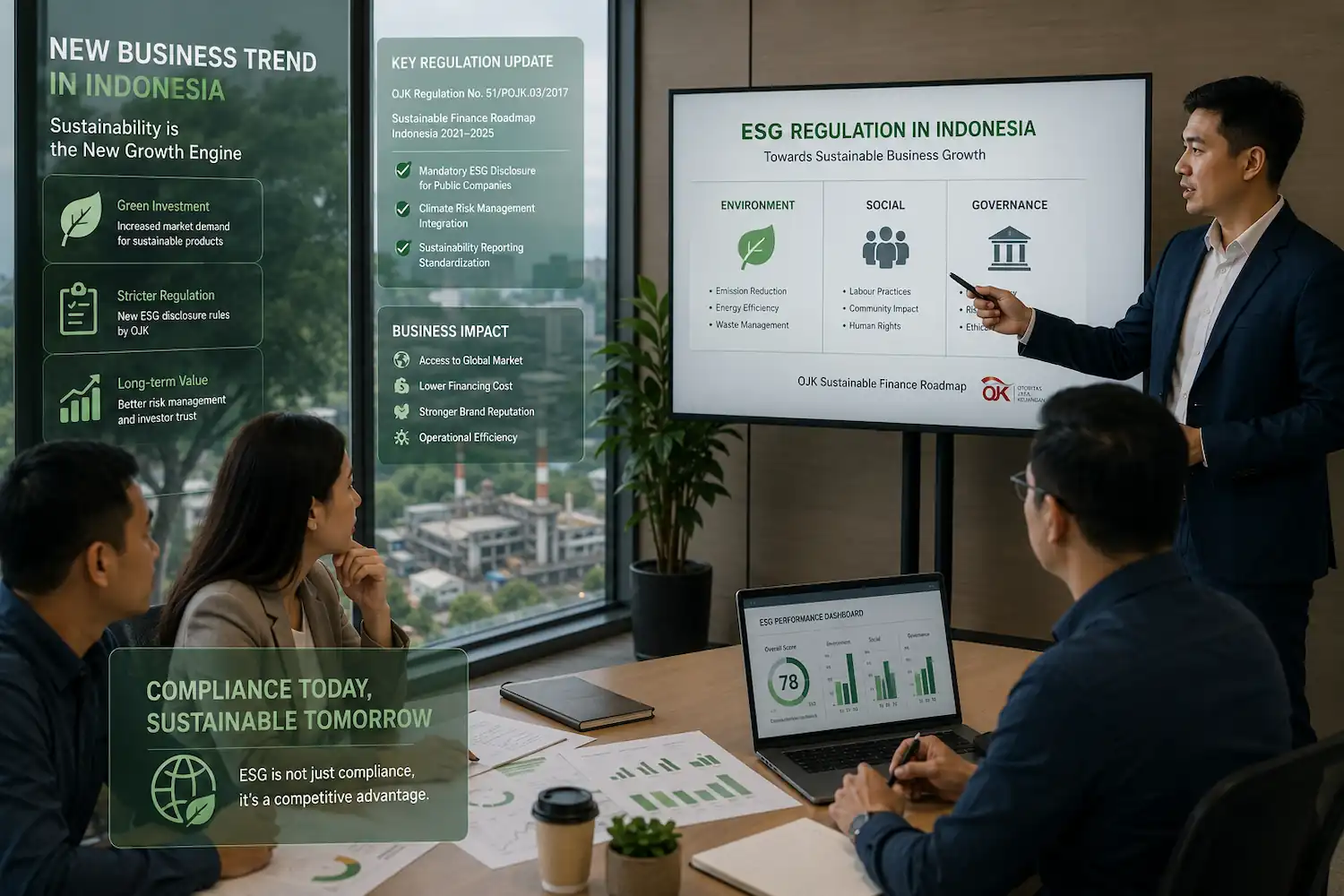
The story above has become a harsh reality for many business owners who underestimated sustainability. This week, the industry was shaken by decisive action from the Financial Services Authority (OJK), which released updated guidelines regarding corporate Environmental, Social, and Governance (ESG) governance. This policy completely alters the old paradigm. According to periodic reports from the Ministry of Investment/BKPM (2026), green investment realization in Indonesia recorded a growth of 14.3% year-on-year. This figure confirms that large capital now flows exclusively to entities that can concretely prove environmental compliance.
Global capital flows have locked in highly stringent criteria. According to global research from PwC Reports (2026), 78% of institutional investors stated that they prioritize ESG compliance as a key indicator when structuring their funding portfolios. In Indonesia, this transformation is moving rapidly from upstream sectors down to mid-sized processing industries.
Why the Old Framework is Collapsing
Many executives remain trapped in the mindset that environmental compliance is a cost center that reduces profitability. They postpone machinery modernization, resist digitalizing supply chains, and ignore workforce risk protection. This defensive strategy is actually a ticking time bomb.
The reality is different: ignoring the new standardization means closing the door to bank capital access and strategic partnerships. As national banks begin to tighten credit distribution based on green incentives, companies with rigid conventional systems must face significantly higher interest rates. Operational efficiency can no longer be achieved through energy-wasting manual methods.
Integrating Compliance into Core Systems
Solving this challenge demands a total, comprehensive overhaul, not just public relations cosmetics. The mandatory first step is to build an internal data infrastructure capable of tracking carbon footprints and energy efficiency automatically. This is where custom technology integration plays a crucial role.
Every line of business—from manufacturing to distribution—must be connected within a transparent ecosystem. Companies that have successfully made this transition are proven to cut logistics waste costs by up to a third of their normal budgets, while simultaneously securing their positions as priority partners for global brands.
The Strategic Role of Gaticorp Ecosystem
At GATICORP, we view these new regulations as a golden opportunity to elevate the competitive edge of national industries. Through our vision of a Modern Indonesian Business Ecosystem, we engineer cross-line solutions that help your business adapt seamlessly. We integrate earnest precision (Gati) with conscious integrity (Eling) to foster resilient responsibility (Sembada).
Through our Digital Product Studio, we build custom data tools to track your operational efficiency. Concurrently, our Corporate Insurance Agency line stands ready to secure your company's assets and employee benefits through adaptive risk protection compliant with the latest regulations.
FAQ
- Do these new OJK ESG rules apply to medium-sized businesses? Yes. Although enforcement begins with public companies, the impact flows down directly because large enterprises are required to ensure all vendors in their supply chain meet the same green standards.
- How does digital technology assist in meeting green investment standards? Custom applications and integrated data systems make it easier for companies to conduct emission audits, monitor energy consumption, and present valid compliance reports to investors or banks.
- What is the first step a company must take to start this transition? Conduct an internal readiness audit, transition operational data management from manual to custom digital systems, and secure asset risk management protection.
The Next Strategic Move
The business world will not wait for your company to be ready to change. Postponing the adoption of sustainable standards is equivalent to planning a gradual market retreat. Secure your business sovereignty, maximize operational efficiency, and meet global investment standards today. Consult your custom data system development and corporate risk management strategies with our senior specialists at business@gaticorp.com. Let us build a resilient and impactful business ecosystem together with Gaticorp.
Sources:
- Financial Services Authority (OJK). (2026). Indonesia Corporate ESG Standardization Guidelines 2026.
- Ministry of Investment/BKPM. (2026). Sustainable Investment Realization Report Q2-2026.
- PwC Reports. (2026). Global Institutional Investor ESG Trust Survey.
Published: June 29, 2026
Source and editorial notes are managed through GATICORP CMS.