
Indonesia recorded 104.30 million domestic tourist trips in August 2026, up 11.47% year on year. Foreign tourist arrivals reached 1.60 million, while the occupancy rate of star-rated hotels rose to 52.52%, 2.01 percentage points higher than a year earlier. By the most visible measures, travel activity continues to expand. Badan Pusat Statistik Indonesia
For hotels, restaurants, retailers, transport providers, activity operators and small businesses in destination economies, however, visitor volume is only the starting point. A destination can be busy without keeping travellers for long. High footfall can coexist with limited spending, while higher tourism expenditure does not necessarily mean that value is broadly distributed among local businesses.
The more useful business question is therefore not simply how many people are travelling, but where, for how long and with whom they spend their money.
A Large Market Does Not Guarantee Broad Distribution
Indonesia's tourism economy is already substantial. The 2023–2025 Tourism Satellite Account records Tourism Direct Gross Domestic Product of IDR1,138.90 trillion in 2025, equivalent to 4.78% of national GDP. Internal tourism consumption reached IDR2,408.97 trillion, including about IDR2,090.31 trillion attributed to domestic tourism and IDR318.66 trillion to inbound tourism. Kementerian Pariwisata
Those numbers establish the scale of demand, but they should not be reduced to a simple spending-per-trip calculation. Tourism Satellite Accounts use a broader economic accounting framework, so mechanically dividing aggregate tourism consumption by trip counts risks producing a misleading number.
For businesses, the more important issue is how that demand translates into transactions at destination level.
Indonesia's Tourism Ministry has increasingly made the same distinction. Visitor growth, it argues, needs to translate into longer stays, higher spending, better experiences and broader economic benefits for communities. Kementerian Pariwisata
In other words, traffic is not the final outcome. It is the raw material.
From Footfall to Local Economic Capture
Consider two destinations receiving roughly the same number of visitors.
At the first, travellers arrive in the morning and leave later that day. They use transport based elsewhere, make one meal purchase and have limited interaction with the local commercial ecosystem.
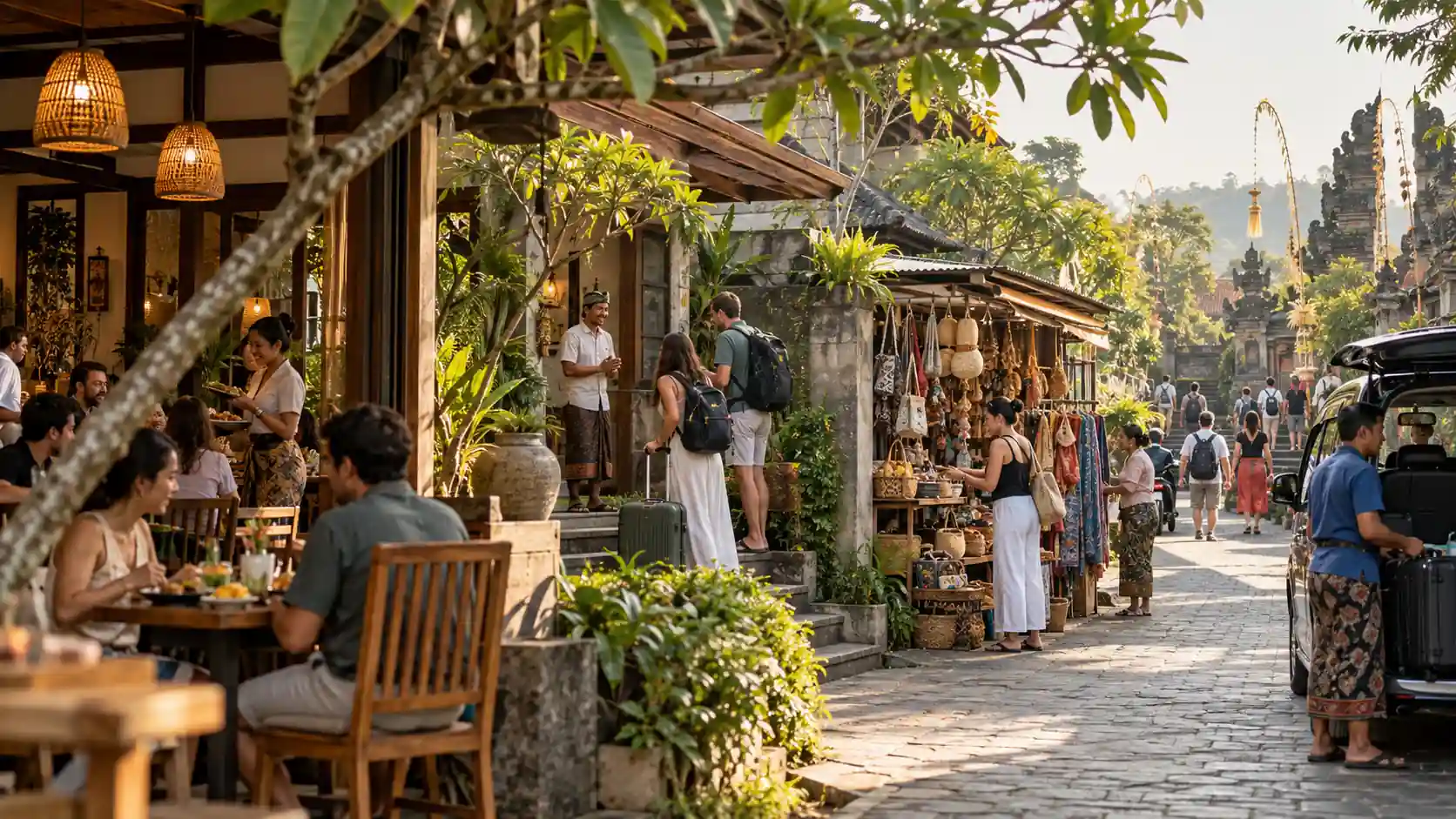
At the second, visitors stay overnight, eat at several independent businesses, purchase local products, use destination-based transport and pay for an additional experience before leaving.
The headcount may be similar, but the local economic impact is very different.
This is where the idea of local economic capture becomes useful. It is not an official BPS statistical measure, but a practical business lens for asking how much visitor expenditure is retained and recirculated within a destination's commercial ecosystem.
The opportunity is therefore not only to increase footfall, but to expand the number of meaningful transactions that can take place across a traveller's journey.
Designing a Journey That Creates Transactions
Many of the strongest opportunities sit between businesses that currently operate independently.
A hotel can connect guests with independent restaurants, local mobility providers, crafts, wellness, guided experiences or nearby events. A convention does not have to end at the venue: participants can extend their activity into dining, shopping, attractions and local services.
This is also the logic behind Indonesia's push to connect MICE activity with destination experiences. The Tourism Ministry notes that event spending can flow beyond venues into accommodation, restaurants, transportation, MSMEs and the creative economy. Kementerian Pariwisata
Domestic packaged travel offers another example. Indonesia recorded approximately 1.20 billion domestic tourist trips in 2025, while tourism programmes in 2026 have sought to connect travel operators with tourism villages, transport providers, cultural products and other businesses through more integrated trip offerings. Kementerian Pariwisata
For a business owner, the implication is practical: do not merely wait for travellers to arrive. Create reasons for a second, third and fourth transaction.
Measure More Than Visitor Numbers
Visitor counts and hotel occupancy remain useful indicators, but they do not fully describe demand quality.
Businesses can learn more by monitoring length of stay, average transaction value, visitor-to-buyer conversion, number of product categories purchased, repeat spending and the participation of local suppliers in the revenue chain.
Even occupancy tells a different story when combined with duration and spending. A heavily visited destination dominated by short stays may represent a very different commercial opportunity from a smaller destination that persuades travellers to remain longer and consume more services.
Indonesia's next tourism opportunity, therefore, is not simply more travel.
The greater opportunity is to turn each trip into a sequence of economic activity—sleeping, eating, moving, shopping, experiencing and eventually returning. For destinations and businesses alike, visitor growth creates its strongest value when the movement of people becomes a broader movement of income.
Sources & Editorial Notes
Primary sources are BPS Tourism Statistics for August 2026, BPS Tourism Satellite Account Indonesia 2023–2025, and Tourism Ministry releases on tourism value, domestic travel and MICE. Badan Pusat Statistik Indonesia
“Local economic capture” is used as a business-analysis concept rather than an official Indonesian tourism indicator. TSA consumption figures should not be interpreted as simple per-trip expenditure without additional methodological work.
Published: October 6, 2026