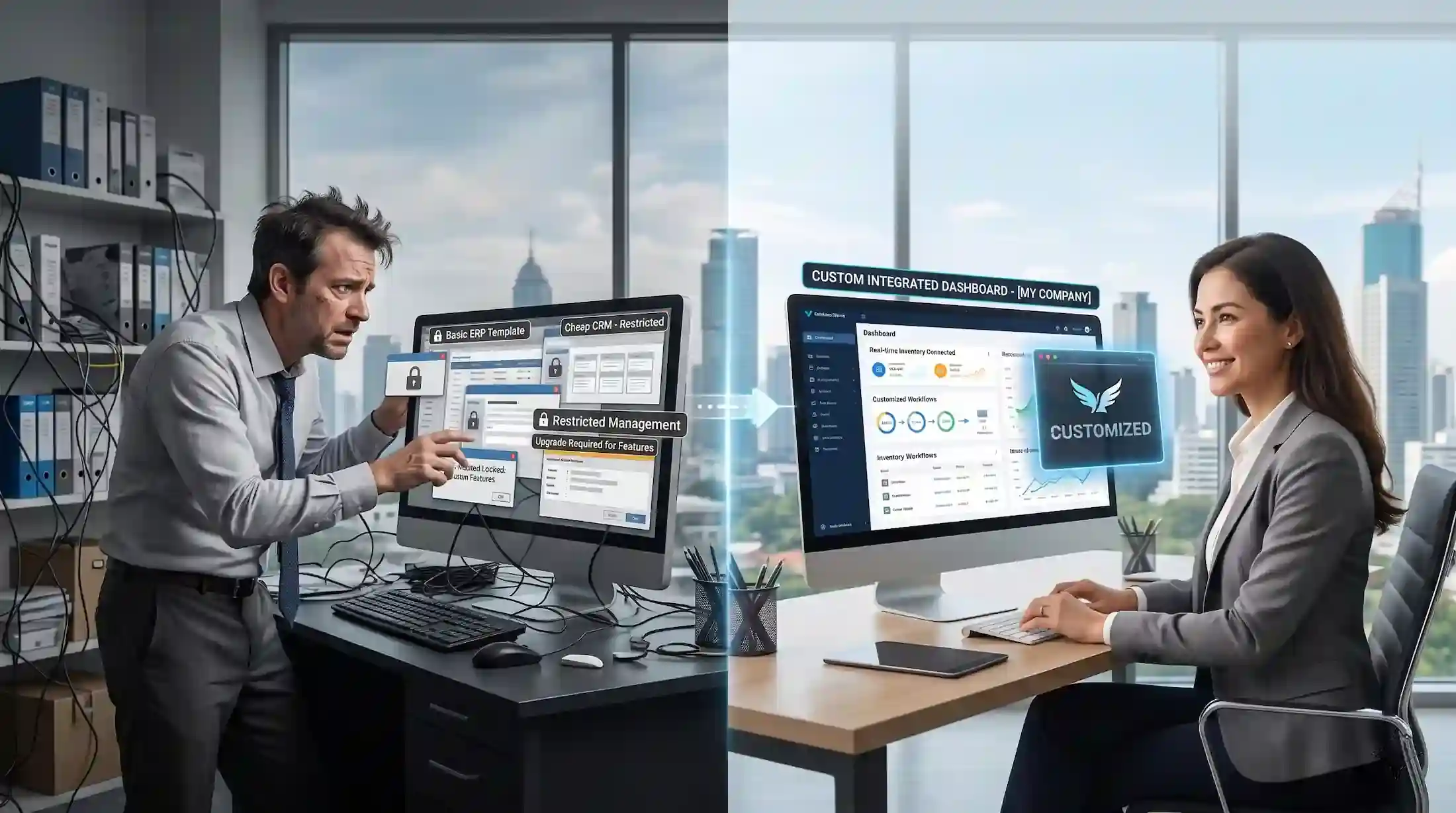

Picture a Jakarta-based logistics company forced to alter its entire field workflow just to adapt to a newly purchased, pre-packaged software application. Instead of accelerating productivity, staff spent two extra hours daily manually forcing data into a rigid system. This is a common reality. Many business owners fall into the illusion that cheap, instant applications will solve all their management bottlenecks.
The Efficiency Illusion of Off-the-Shelf Apps
The reality on the ground tells a very different story. Deploying off-the-shelf software often triggers hidden complications. Enterprises are forced to compromise. Seamless business operations that took years to optimize are abruptly dismantled simply because the platform cannot support customization.
According to a combined report from TechInAsia and DailySocial (2026), roughly 64% to 67% of local enterprises report that ready-made software fails to accommodate unique domestic regulations and the dynamic Indonesian market landscape. As a company scales, seat-licensing fees skyrocket while features remain strictly constrained.
Breaking Barriers with Custom Software Development
This is precisely where custom software development becomes vital. A tailor-made solution operates like a bespoke suit—perfectly fitted, comfortable, and allowing maximum mobility. The technology adapts directly to the company's unique operations, never the other way around.
Based on insights from McKinsey Digital (2026), enterprises migrating toward adaptive data architectures via custom digital products experience up to a 35% surge in operational efficiency. This is not just a vanity metric. This leap stems directly from eliminating data redundancy and uniting siloed departments under a single, transparent control dashboard.
Designing the Future with a Digital Product Studio
True digital transformation demands a strategic partner deeply familiar with the modern Indonesian business ecosystem. You do not just need team members who write code; you need technology architects capable of translating corporate vision into adaptive, scalable ecosystems.
The Digital Product Studio arm of Gaticorp bridges this exact gap. Grounded in Earnest Precision, every custom platform is built with meticulous detail to ensure data tools integrate flawlessly without risking corporate digital assets.
FAQ
- Why is custom software development better than ready-made apps? Custom platforms are engineered around your specific operational workflows, preventing forced structural overhauls and providing seamless scalability for future expansion.
- How do you measure cost efficiency in custom digital product creation? While upfront costs are higher, custom systems eliminate compounding monthly user fees and heavily reduce expensive manual operational hours.
- What role does a Digital Product Studio play in corporate digital transformation? It serves as a strategic partner to design, build, and deploy adaptive tech ecosystems aligned with local compliances and corporate milestones.
The Next Move for Business Leaders
Stop compromising with technology that bottlenecks your expansion. Re-evaluate whether your current platforms actually empower your workforce or quietly slow them down. Take absolute control of your enterprise operations with adaptive digital architecture. Contact our advisory experts at business@gaticorp.com to begin mapping out a custom system blueprint engineered to scale your enterprise to the next tier.
Sources:
- TechInAsia.com (2026) - Indonesia Enterprise Cloud & AI Adoption Report 2026
- DailySocial.id (2026) - Assessing Custom System Readiness in Local Enterprises
- McKinsey Digital (2026) - Operational Efficiency Data in Technological System Integration
Published: June 27, 2026
Source and editorial notes are managed through GATICORP CMS.