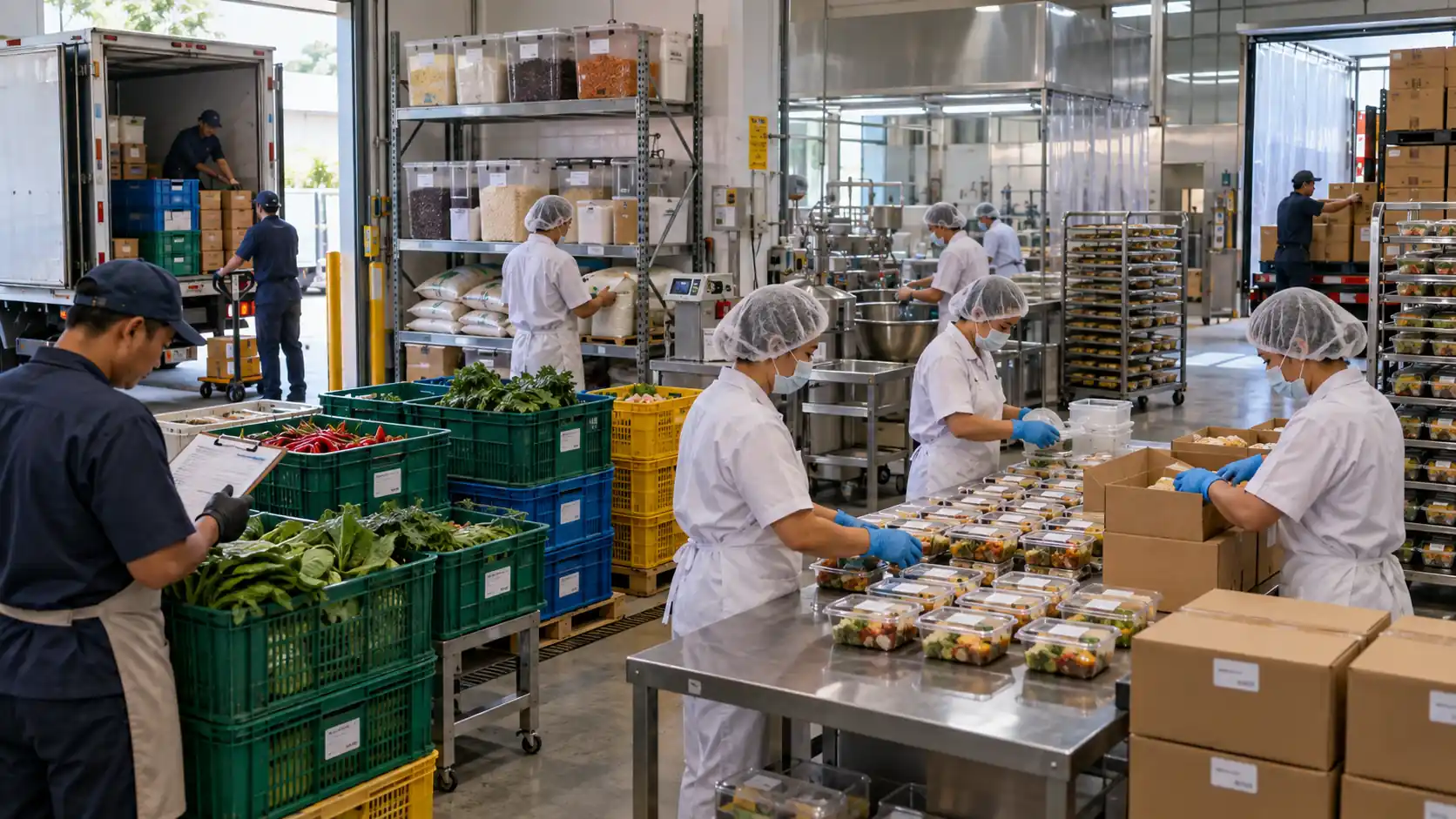

In June 2026, Indonesia's Food and Drug Authority issued BPOM Regulation No. 10 of 2026 on Nutrition Information on Processed Food Labels. The regulation replaced several earlier nutrition-labelling rules and now forms the current framework for Nutrition Information—or ING—on processed food. New registration applications received from 3 August 2026 are required to follow the new provisions, while products already in process or holding earlier approvals have a transition period until 17 June 2028.
From the outside, a regulatory change like this can look like a packaging task.
Change the table. Update the artwork. Print a new package.
Nutrition information, however, begins long before the design file is opened.
It starts with the product itself.
The Label Starts With the Formula
A nutrition panel is not decoration added to a package.
Its numbers come from somewhere.
There are ingredients, quantities, formulation, production processes, product sizes, serving sizes and nutritional data underlying what customers eventually see.
When a formulation changes materially, therefore, the information on the label deserves another review.
A business may reduce sugar, replace a major ingredient, change a product size or introduce a new variant. Operationally, it should not assume that old artwork remains correct simply because the package looks similar.
BPOM's registration information itself treats differences in product composition and label design as relevant factors in processed-food registration.
The principle is important:
a label represents a particular version of a product.
When the product changes, the representation may need to be revalidated.
One Product Can Develop Several Versions of the Truth
Problems begin when nobody clearly owns product information.
R&D holds the newest recipe.
Production is still working from an earlier bill of materials.
The designer opens the last packaging file saved in a folder.
Marketing copies nutrition numbers from an old presentation.
A packaging supplier has already printed three months of inventory.
Everyone may be acting in good faith while working with different versions of the data.
The final error then appears as a wrong number, ingredient statement or outdated artwork.
The root problem is actually product-data governance.
A healthier change process might connect the stages more deliberately:
formula change → product-data review → nutrition-data review → regulatory-impact check → artwork update where needed → packaging approval → correct version released into production.
This is a GATICORP editorial workflow, not an official BPOM procedure.
Its purpose is to connect functions that are often managed separately.
Micro Businesses Have a More Practical Route—with Limits
Indonesia's new framework also shows that nutrition-data sourcing can differ depending on the business and product.
BPOM updated its independent ING-printing application in 2026. For micro businesses, 465 categories of processed food have nutrition values established under BPOM Head Decision No. 265 of 2026. A qualifying micro business whose product falls within the listed categories can calculate and print Nutrition Information without commissioning its own laboratory analysis.
The facilitation does not apply to every MSME product.
BPOM explains that businesses outside the micro category, or micro businesses whose products are not included in the specified group, can use laboratory-analysis data and the other calculation function provided by the system.
BPOM again confirmed in September 2026 that the 465 food types are intended to make compliance easier for eligible micro producers.
Decisions such as “use the old number” or “copy the nutrition panel from a similar product” are therefore not product-data strategies.
The source of the numbers should be explainable.
Packaging Sits Where Many Functions Meet
Packaging is often treated as the design team's territory.
In practice, many functions meet there.
R&D determines what is inside the product.
Regulatory defines required information.
Quality protects the basis of that information.
Brand shapes communication.
Design creates hierarchy and readability.
Procurement purchases materials.
Printers manufacture packaging.
Operations must make sure the correct SKU uses the correct package.
Indonesia's Ministry of Industry has also emphasised in 2026 that packaging now plays a broader role than physical protection alone, including product identity, communication, added value and market competitiveness.
Add mandatory product information, and packaging becomes an interface between the company and the consumer.
An error behind the scenes can be printed thousands of times.
A Small Change Can Travel Downstream
Consider a beverage that changes its serving size.
That decision may affect how information per serving needs to be calculated or presented.
Artwork may then need revision.
If the panel dimensions change, layout may shift.
A printer needs the new file.
Old packaging may still exist in inventory.
Production planning then needs to know when the old version stops and the new one begins.
For beverages, the context is becoming even more visible because Regulation 10/2026 also introduces Nutri-Level progressively as front-of-pack nutrition information. BPOM says the first phase applies to beverage categories with a transition period through 17 June 2028, while the full ING table continues to provide more detailed nutrition information.
One regulatory change can therefore travel from regulatory affairs into R&D, design, procurement, packaging inventory and production.
A label should not be treated as a static file.
It is part of product change management.
Build One Source of Truth
For a smaller food company, one source of truth does not require expensive enterprise software.
A disciplined spreadsheet can be a reasonable starting point.
What matters is knowing which formulation is active, where the nutrition data came from, which serving size applies, which regulatory basis is being used, the approved artwork version, approval date, associated SKU and who authorised the change.
As the business grows, that structure can evolve into formal recipe management, product-information management or approval workflows.
The principle remains the same:
one product should not have five versions of the truth across five departments.
The Nutrition Information visible to a customer may occupy only a small section of the package.
Its accuracy, however, says something much larger about the business: whether product information can remain consistent from formulation all the way to the shelf.
Packaging is not merely the final place where design is applied.
It is where company decisions become information for the customer.
Sources & Editorial Notes
- BPOM — Regulation No. 10 of 2026 on Nutrition Information on Processed Food Labels. Issued on 9 June and promulgated on 17 June 2026. The regulation remains in force and repeals several previous ING provisions, including Regulation 26/2021 and Regulation 16/2020.
- BPOM Directorate of Processed Food Registration — implementation notice for Regulation 10/2026. New registration applications received from 3 August 2026 are required to use the new provisions. Products already under review or holding earlier PB-UMKU approvals receive a transition period through 17 June 2028.
- BPOM Head Decision No. 265 of 2026. Effective from 23 June 2026 and establishing nutrition-content values for processed foods produced by micro businesses within the scope of the decision.
- BPOM — 2026 Independent ING Printing Application. Used to cross-check that 465 processed-food types for micro businesses can use established reference values without commissioning their own laboratory tests; other businesses or micro businesses with products outside the list use the laboratory-data route provided in the system.
- BPOM, September 2026 — Nutri-Level and micro-business facilitation. Used to cross-check the 465-category figure and the phased Nutri-Level implementation for beverage products.
- BPOM — processed-food registration information. Used to show that differences in composition and label design are relevant factors in separate registration treatment.
- Indonesia Ministry of Industry, May 2026 — strategic role of packaging. Used as context for packaging as protection, identity, communication and competitiveness rather than decoration alone.
- The Formula → Product Data → Nutrition Data → Regulatory Review → Packaging Artwork → Production SKU sequence is a GATICORP editorial framework, not an official BPOM workflow.
- This article does not state that every recipe change automatically triggers the same registration action. Regulatory consequences depend on the nature of the change, the product and applicable provisions.
- This article is for business education and does not constitute product-specific food-regulatory, nutrition or registration advice.
Published: October 12, 2026