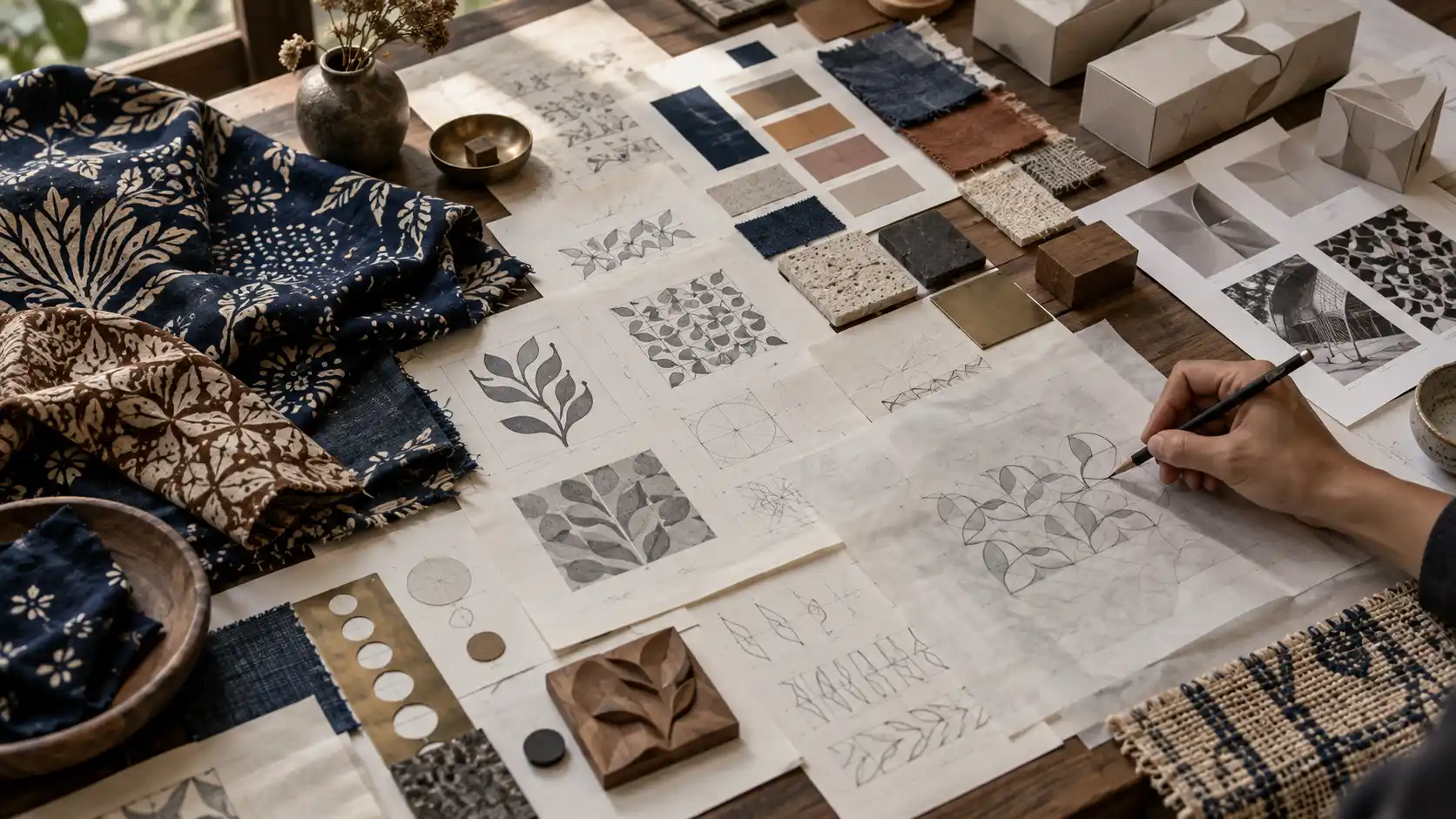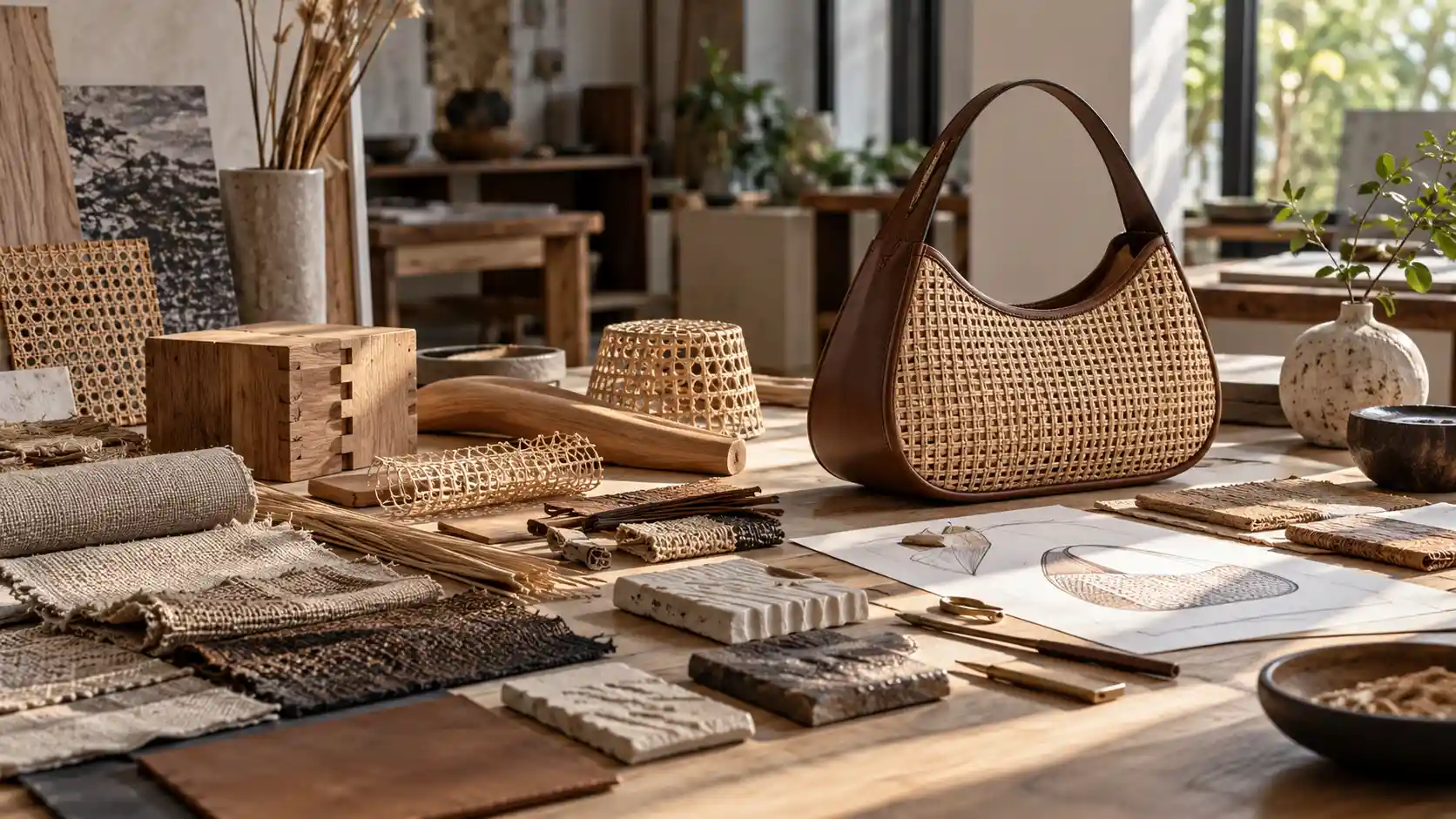

In early October 2026, Indonesia's Ministry of Industry again encouraged fashion and craft SMEs to begin product development by understanding market needs. Its Design Canvas & Design Maker programme moves from consumer needs and preferences toward ideas, design, prototypes, function and commercial potential.
Several days later, the ministry again described cultural richness, creativity, craft skills and diverse local resources as important industrial assets—while placing them alongside design innovation, quality and changing market preferences.
Together, those ideas raise a useful design question:
What should a contemporary Indonesian product actually look like?
Does a chair need a traditional motif to feel local? Must a garment display heritage textile literally? Does packaging need an ethnic pattern to communicate Indonesian identity?
Not necessarily.
Identity Can Live Below the Surface
Design often uses the fastest available visual shortcut to express origin.
A batik pattern is applied.
A traditional motif becomes surface graphics.
A regional symbol is inserted into packaging.
There is nothing inherently wrong with ornamentation. In the appropriate context, ornament can be an authentic part of expression and craftsmanship.
The problem begins when culture is treated only as a skin.
A product can carry local identity through something much more structural: its material, joining technique, weaving method, dye process, understanding of climate, proportions, manufacturing method, ritual of use, or the skills held by particular craftspeople.
Through that approach, a contemporary chair does not need to resemble a “traditional object” to contain local knowledge.
Its identity can live in how it is made.
Tradition Is Not a Free Motif Library
WIPO defines Traditional Cultural Expressions, or TCEs, broadly. They can include art, designs, signs, symbols, performances, handicrafts, narratives and other expressions that form part of the identity and heritage of traditional or Indigenous communities and are transmitted across generations.
That makes cultural references different from ordinary visual trends.
For a community, a motif, garment, technique or symbol may carry history, belief, social meaning and identity.
WIPO specifically cautions that elements of Indigenous Peoples' TCEs used without consent or in inappropriate ways can cause harm or offence even where a designer did not intend to do so. Its work therefore encourages dialogue and more fair and equitable interactions between communities and fashion businesses.
The designer's first question should therefore not simply be:
“Would this motif look good on the product?”
An earlier question matters:
“What exactly are we using?”
Indonesia Also Recognises Traditional Cultural Expressions
Indonesia recognises Communal Intellectual Property, including Traditional Cultural Expressions. DJKI describes EBTs as tangible or intangible expressions of creative work that demonstrate a traditional culture held communally and across generations.
Copyright Law No. 28 of 2014 also addresses Traditional Cultural Expressions and identifies forms including verbal expression, music, movement, theatre, visual arts made from a range of materials, and traditional ceremonies. The legal character of an EBT is not the same as an individual's copyright in a newly created original motif.
This matters to designers and brands because “traditional” does not automatically mean free of context.
In 2026, DJKI again emphasised documentation and inventory work around traditional knowledge and cultural expressions as part of strengthening protection for intellectual assets that are communal and passed between generations.
Specific projects may require detailed legal and community-specific assessment.
As a design principle, however, the lesson is straightforward: understand the origin before translating the expression.
Modernisation Does Not Require Erasing Tradition
The opposite concern also exists.
If a motif, form or technique is not reproduced literally, does the product become less authentic?
Not necessarily.
The Ministry of Industry itself encourages fashion and craft businesses to understand consumers at the beginning of the design process and develop prototypes around market opportunities. Local products still operate within changing lifestyles, functionality, ergonomics, price points and customer expectations.
Living traditions interact with their time.
A weaving technique can produce a completely new product form.
Rattan knowledge can become part of minimal contemporary furniture construction.
A dyeing process may appear in a silhouette that never existed historically.
A local material can become a component in a new lifestyle or industrial product.
Preservation does not always require freezing an old object in its original commercial form.
What matters is knowing what is being translated, who holds or safeguards the knowledge, and what should not be separated from its cultural context.
Collaboration Is Stronger Than “Inspired By”
The phrase inspired by often sounds harmless.
But when a commercial brand derives value from a community's knowledge, expression or craft skill, a more meaningful relationship may involve collaboration, consent, attribution, creative control and fair benefit.
WIPO's dialogue between Indigenous representatives and fashion companies has highlighted issues including compensation, creative control, protection and fair interaction. WIPO has also developed draft steps intended to help fashion companies engage with Indigenous artists and communities when considering the use of TCEs in fashion projects.
Not every use of a local material presents the same situation.
Purchasing an ordinary commercial material is different from reproducing a sacred symbol. Co-developing a new object with artisans is different from copying a traditional motif from an online photograph.
Design teams therefore need judgement, not merely a checklist.
From Cultural Source to Product
As a GATICORP editorial framework:
Source → Meaning → Material / Technique → Contemporary Use → Market Context → Attribution / Collaboration → Product
Source — where does the reference come from?
Meaning — what is its function, significance or context?
Material / Technique — is its primary value located in a motif, material, craftsmanship or knowledge of making?
Contemporary Use — how can that knowledge answer a current function?
Market Context — does the design make sense for its user, price point, channel and positioning?
Attribution / Collaboration — should artisans, communities or custodians be identified, engaged, consulted or share in the value?
Product — only then is the source translated into an object intended for the market.
This is not a WIPO or DJKI legal procedure. It is a way to prevent a design process from jumping directly from “cultural reference” to “put it on the product”.
A Local Product Does Not Need to Become a Souvenir
The global market does not require every Indonesian product to loudly announce that it comes from Indonesia.
Sometimes the more powerful product is highly contemporary at first glance, yet reveals material, technique, detail, construction knowledge or production relationships that could not easily be separated from the place where it was made.
Indonesia's Ministry of Industry itself places design, consumer understanding, quality, innovation and market awareness alongside cultural richness and craft capability in its competitiveness agenda.
That gives designers two responsibilities.
Do not freeze culture into an artefact of the past.
But do not reduce it to a decorative asset either.
A local product does not have to look traditional.
The more important question is whether locality genuinely lives inside the design.
- Indonesia Ministry of Industry, 2 October 2026 — Market-Oriented Design Innovation. Used for the consumer-oriented product-development process and Design Canvas / Design Maker context. Ministry of Industry: Market-Oriented Design Innovation
- Indonesia Ministry of Industry, 7 October 2026 — Craft Industry Market Development. Used for the relationship between cultural resources, craft skills, design innovation, quality and market needs. Ministry of Industry: Craft Industry Development 2026
- WIPO — Traditional Cultural Expressions. Used for the definition and community identity/heritage context of TCEs. WIPO: Traditional Cultural Expressions
- WIPO — Traditional Cultural Expressions and Fashion. Used for consent, harm, appropriate use, dialogue and equitable collaboration. WIPO: Indigenous Peoples and Fashion
- Indonesia Directorate General of Intellectual Property — Communal Intellectual Property. Used for the Indonesian definition of Traditional Cultural Expressions. DJKI: Communal Intellectual Property
- DJKI, 12 January 2026 — Copyright, Industrial Design, Traditional Cultural Expressions and Geographical Indications. Used to distinguish newly created individual motifs from communal traditional expressions. DJKI: Understanding Motifs and Traditional Cultural Expressions
- Editorial note: several 2026 Ministry of Industry releases report craft-export figures using scopes or periods that are not sufficiently consistent to treat automatically as one comparable time series. The article therefore does not use those figures as evidence for its central argument. Consent, attribution, collaboration and benefit are discussed as design and engagement principles; specific legal obligations depend on the expression, community, use, contracts and jurisdiction. Source → Meaning → Material / Technique → Contemporary Use → Market Context → Attribution / Collaboration → Product is a GATICORP editorial framework.
Published: October 18, 2026