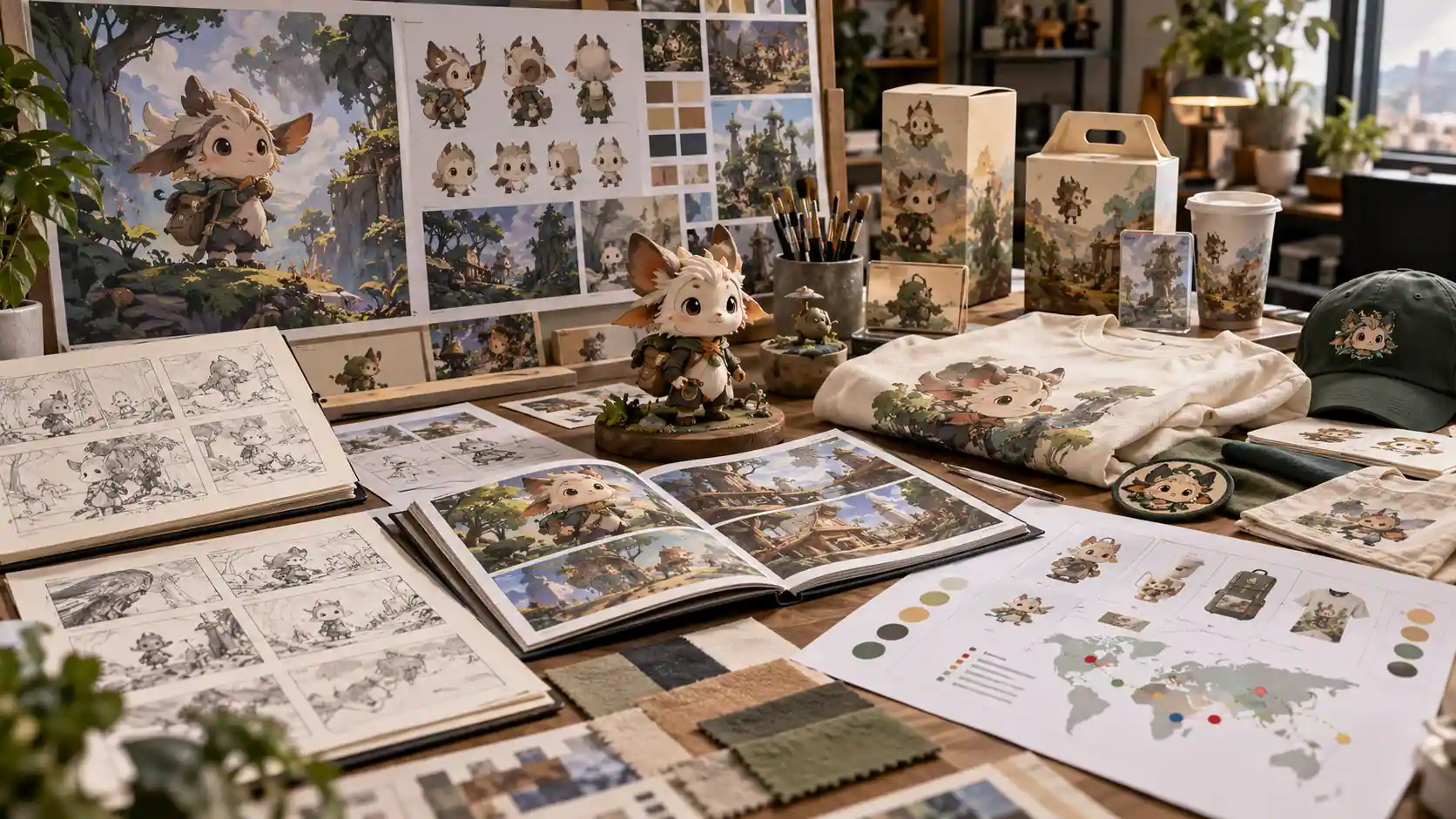

A brand can publish content every day.
Three videos a week.
Stories throughout the day.
Trending audio.
New formats.
Yet there is a more revealing question:
If the username disappeared, would customers still recognise whose product they were seeing?
In August, Indonesia's Ministry of Industry encouraged fashion and craft SMEs to use digital channels not only for marketing but also to build brand identity, expand markets and strengthen consumer relationships.[1]
That distinction matters.
Because producing content is not automatically the same as building a brand.
Content is activity; a brand is a pattern people remember
One video can go viral.
One product image can attract thousands of likes.
One promotion can lift weekend sales.
Brand-building works on a different timeline.
It emerges from patterns customers repeatedly encounter:
what the company sells;
who it serves;
how it speaks;
what quality feels like;
where its pricing sits;
how the product looks;
and what happens after the transaction.
Consistency therefore does not mean making every post look identical.
It means customers gradually understand:
“This is what this brand tends to be.”
Follow trends without losing character
Digital platforms move quickly.
Formats change.
Audio changes.
Algorithms change.
Audience behaviour changes.
Local brands do not need to ignore trends.
The problem begins when every trend changes the brand's personality.
Playful on Monday.
Luxury on Wednesday.
Aggressive sales language on Friday.
Inspirational by Sunday.
Individually, each piece of content may work.
Collectively, the identity can disappear.
A useful filter is:
Does this format help customers understand our brand, or does it merely help us join today's conversation?
The product remains at the centre
Through its Creative Business Incubator, the Ministry of Industry says SMEs need more than product quality: they also need consumer understanding, identity, differentiation and measurable business strategy.[2]
The reverse is equally important.
Branding cannot replace the product.
Good content may bring people in.
Real experience determines whether they return.
Material.
Fit.
Taste.
Packaging.
Durability.
Service.
Delivery.
After-sales response.
Digital branding therefore has to connect to operations.
The product must be able to keep the promise made by the content.
Physical and digital experiences should reinforce each other
BTN Indonesia Fashion Week 2026 illustrates the scale of physical interaction between brands and customers. The Ministry of Industry reported more than 200 designers, 500 exhibitors and over 35,000 visitors during the five-day event, with aggregate transactions exceeding Rp10 billion.[3]
A physical event offers something a feed cannot fully reproduce.
Customers touch the material.
Inspect finishing.
Try products.
Speak with the people behind the brand.
Compare alternatives.
When the event ends, however, digital channels often take over the relationship.
Can the customer find the product again?
Is the catalogue clear?
Does the online presentation match the real product?
Is purchasing easy?
Does follow-up happen?
Strong brands allow offline recognition and online recognition to reinforce each other.
Likes are not the only useful measure
Not every piece of content should produce an immediate sale.
Educational content can build confidence.
Behind-the-scenes content can communicate craftsmanship.
Founder stories provide context.
Customer styling creates inspiration.
Business still benefits from understanding how content relates to customer movement.
Useful measures can follow the journey:
reach;
profile visits;
catalogue or website visits;
enquiries;
add-to-cart;
purchases;
repeat orders.
A small business does not need an elaborate analytics operation.
It does need to know:
Where does the attention go next?
Otherwise, social media can become a machine for activity without business feedback.
Customers help define the brand too
A brand is not only what the company broadcasts.
Customers shape it through:
reviews;
comments;
unboxing;
complaints;
repeat purchases;
user-generated content;
and word of mouth.
Customer relationships are therefore not something that begins after brand-building.
They are part of brand-building.
If a brand's visuals say “premium” but delivery is inconsistent and packaging repeatedly arrives damaged, customers will create their own definition of what “premium” means.
Experience always has a voice.
Digital channels can also function as research
Digital platforms give small brands access to something that was once expensive: fast customer feedback.
Which questions repeat?
Which products are repeatedly saved?
Which sizes generate enquiries?
Which content produces catalogue requests?
Which complaints keep returning?
When and where do customers actually use the product?
This does not need to become a big-data project.
Patterns in ordinary customer conversations can already inform product development.
The Ministry of Industry itself emphasises understanding consumer characteristics as part of strengthening fashion and craft SMEs.[2]
Brand communication should increasingly be two-way.
Five steps from content to brand
As a GATICORP editorial framework, a local brand can review its digital system through five areas.
1. Position
Who is the brand for, and which customer need or aspiration does it address?
2. Recognise
What makes it recognisable—product form, colour, photography, material, voice or service style?
3. Communicate
Which stories and content pillars reinforce that position?
4. Convert
How does attention move into an enquiry, catalogue visit, purchase or physical-store visit?
5. Retain
What makes customers return, recommend or remain connected after purchasing?
This is not an official Ministry methodology.
It distinguishes a content calendar from a brand-building system.
Strong brands do not always need to be loud
On digital channels, visibility can easily become the final objective.
More posts.
More followers.
More reach.
Visibility matters.
Brand-building has a harder job:
help customers recognise something before they even see its name.
That recognition grows from consistent products, visual language, customer experience, communication and values reinforced over time.
Content can make a brand visible today.
Identity makes it memorable tomorrow.
Sources:
[1] Directorate General of Small, Medium and Miscellaneous Industries, Indonesia Ministry of Industry. Expanding Markets: Improving Digital Capabilities of Fashion and Craft SMEs. 21 August 2026. Positions digital channels as tools for marketing, identity, market reach and consumer relationships.
[2] Directorate General IKMA, Ministry of Industry. Creative Business Incubator Strengthens Fashion and Craft SME Competitiveness. 18 August 2026. Highlights consumer understanding, differentiation, identity and business strategy.
[3] Directorate General IKMA, Ministry of Industry. Ministry-Supported SMEs Target Global Markets at BTN Indonesia Fashion Week 2026. 14 August 2026. Reports event-level figures for designers, exhibitors, visitors and transactions.
[4] Directorate General IKMA, Ministry of Industry. Creative Business Incubator 2026. 23 July 2026. Provides sector output and export context for fashion, craft and textiles.
- Fashion/craft growth and export figures provide sector context; the article does not attribute that growth to digital branding.
- BTN IFW's transaction figure is an aggregate event figure, not average brand revenue or a sales guarantee.
- Likes, reach and follower counts are not treated as direct causal drivers of revenue.
- Brand consistency does not mean identical-looking content.
- The article does not suggest every local brand must use every social platform.
- Customer feedback can inform decisions but is not presented as a substitute for formal research in every case.
- Position → Recognise → Communicate → Convert → Retain is a GATICORP editorial framework.
Published: August 28, 2026