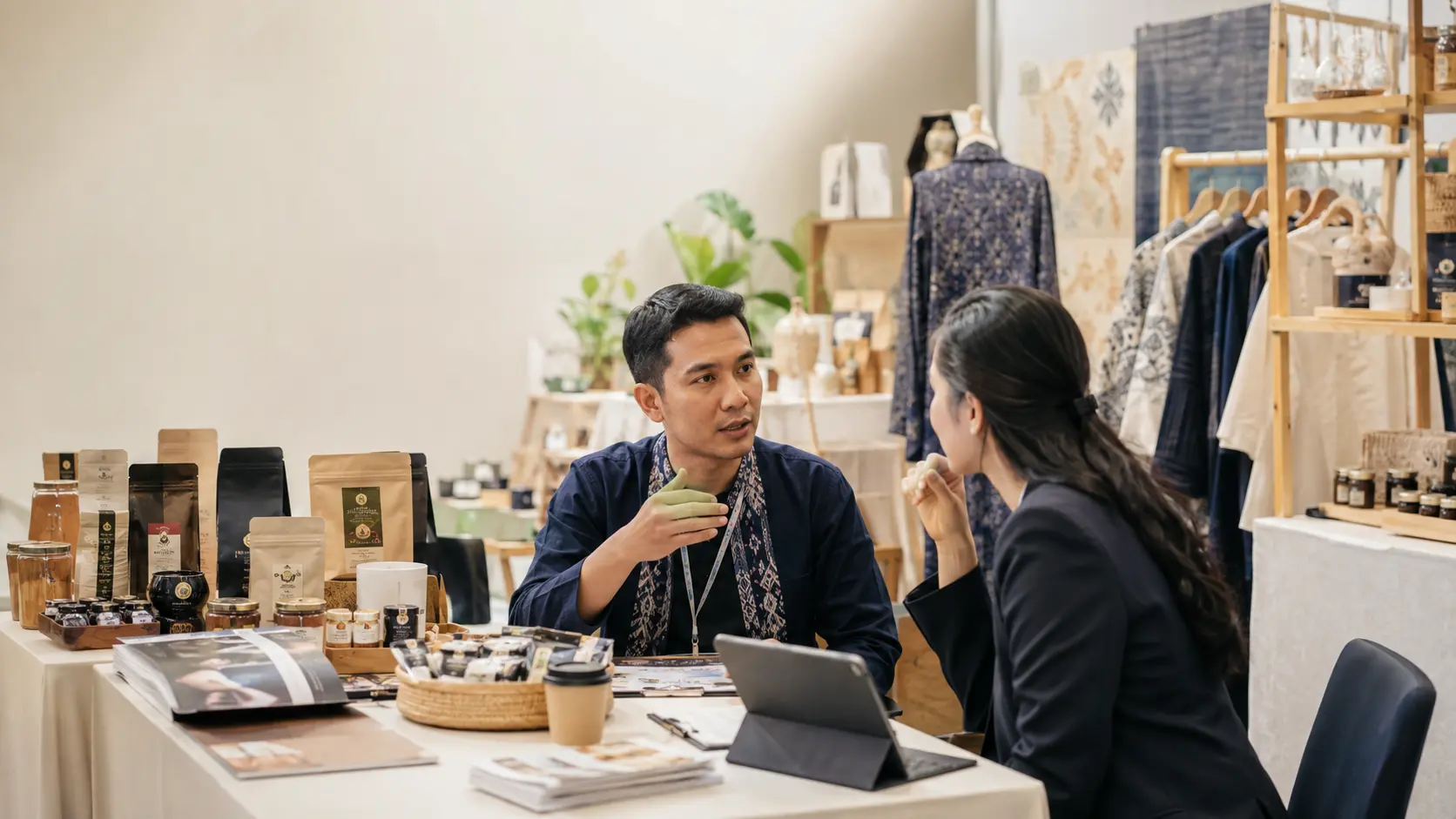

A busy exhibition can create an intuitive impression: the more people see a product, the more successful the event must have been.
For a business, the final measurement is more demanding.
How much of that attention becomes a commercial relationship after the booth closes?
Karya Kreatif Indonesia 2026 provides a useful setting for that question. The 11th KKI runs from 20–23 August, with activities extending beyond product displays into export and financing business matching, corporate connections, innovation and capacity development.[1][2]
The underlying lesson is simple: visibility should be the start of a journey, not its final result.
Exposure matters, but it is not demand
An unfamiliar product can gain thousands of new views through an exhibition, marketplace, social channel or collaboration.
That has real value.
But someone who sees a product is not necessarily a potential customer. A visitor trying a sample may never purchase again.
It helps to separate three stages:
attention — someone notices the product;
interest — they show curiosity or engagement;
commercial intent — they have a reason and realistic ability to buy or work together.
This distinction prevents businesses from measuring success through footfall alone.
A useful lead needs a next step
KKI 2026's export business matching is designed to connect MSMEs with aggregators, importers, distributors, retailers and potential international buyers.[2] Its financing programme connects enterprises with financial institutions.[3]
That makes post-meeting information valuable.
Which buyer requested a catalogue?
Which product interested them?
What volume could they require?
Do they need retail or wholesale pricing?
Are there packaging, certification or delivery standards?
When should the next conversation happen?
A stack of business cards without context easily becomes an archive.
A good lead should have a next action.
Once orders arrive, the problem changes
A large order sounds like the ideal outcome for a small business.
Yet demand creates a new set of questions.
Can production capacity cope?
Can suppliers keep up?
Will quality remain consistent if volume doubles?
How much working capital is needed before payment arrives?
Does the margin remain healthy after distributor discounts, logistics and additional packaging?
This is why “moving up” is more complicated than increasing sales.
Growth without operational and cash-flow readiness can create pressure of its own.
Repeat business says more than one transaction
One of the most useful post-exhibition indicators is what happens several weeks or months later.
Does the customer return?
Does a buyer increase volume after a trial order?
Does a distributor request an additional territory?
Or does the relationship end after the first purchase?
For many SMEs, repeat business reveals more than one large transaction.
It indicates that the product is succeeding outside the temporary attention of an exhibition and that a degree of product-market fit may be developing.
Follow-up therefore should not focus only on making the next sale. Businesses also need to understand why buyers return—or why they do not.
Financing should follow a growth need
KKI also connects MSMEs with financial institutions. Bank Indonesia explains that its financing business matching includes one-on-one meetings and information exchange designed to help businesses and lenders understand financing needs and business conditions.[3]
The important point is that finance should not become an objective by itself.
Capital is useful when attached to something specific: machinery, raw materials for confirmed orders, additional capacity, production working capital or distribution expansion.
Borrowing more without understanding how that capital creates future cash flow can increase risk.
The question becomes less:
“How much credit can I obtain?”
and more:
“Which part of our growth requires capital, and how will that capital pay for itself?”
Five stages after exposure
As a GATICORP editorial framework, an MSME can view the post-exhibition journey in five stages.
1. Capture
Record buyers, resellers, distributors, media and partners systematically rather than simply collecting contact details.
2. Qualify
Separate general visitors from leads with a real need, realistic volume and potential to transact.
3. Convert
Prepare catalogues, wholesale pricing, samples, terms, capacity information and timelines that make a buyer's decision easier.
4. Deliver
Ensure production, quality, packaging, logistics and cash flow can support the order that has been won.
5. Retain
Measure repeat orders, feedback, margin and relationship quality after the first transaction.
This is not an official KKI or Bank Indonesia methodology. It is a practical way of thinking about the conversion of visibility into business growth.
KKI should also be measured after the event
Bank Indonesia's later annual reporting shows that KKI 2025 generated substantial export and financing business matching. Those aggregate results, however, do not guarantee the same outcome for each participant in 2026.[4]
Every brand has different products, channels, capacity and economics.
The full value of an exhibition may therefore only become clear months later.
How many commercial relationships remain active?
How many orders repeat?
Did a new market actually open?
Has the company become operationally stronger?
Ultimately, exposure creates the opportunity to be discovered.
Growth depends on what the business is capable of doing once that discovery happens.
- [1] Karya Kreatif Indonesia / Bank Indonesia. About Karya Kreatif Indonesia 2026. KKI 2026 is the 11th edition and is positioned as more than a product exhibition, including digitalisation, innovation and market-access development.
- [2] Karya Kreatif Indonesia / Bank Indonesia. KKI 2026 Export Business Matching and official 20–23 August agenda.
- [3] Karya Kreatif Indonesia / Bank Indonesia. Financing Business Matching. Describes meetings between MSMEs and financial institutions.
- [4] Bank Indonesia. Indonesia Economic Report 2025, published in 2026. BI's later annual reporting recorded more than 1,400 MSMEs and more than 150,000 visitors at KKI 2025, with export business matching of approximately Rp636 billion and financing business matching of Rp320 billion.
- KKI 2026 is not presented as a guarantee of sales, exports or financing.
- Rp636 billion and Rp320 billion are 2025 outcomes, not 2026 results or targets.
- Earlier 2025 BI publications contained interim figures; this article uses BI's later annual report for historical comparison.
- Capture → Qualify → Convert → Deliver → Retain is a GATICORP editorial framework.
- Visitors, leads and buyers are deliberately treated as different concepts.
- This article is independent editorial analysis, not a KKI or Bank Indonesia advertorial.
Published: August 21, 2026