
Food packaging is often treated as one of the final stages of product development. The formulation is complete, taste approved, pricing calculated, and only then does the business select a pouch, cup, bottle, film or tray.
Indonesia's new food-packaging regulation suggests a different perspective.
OJK—more accurately, Indonesia's Food and Drug Authority, BPOM—Regulation No. 11 of 2026 took effect on 30 June 2026 and replaced the 2019 food-packaging regulation. It covers packaging materials, migration limits, permitted food-contact substances, reusable and recycled packaging, safety assessment and administrative sanctions. Materials directly contacting food need to comply with applicable migration requirements and safe food-contact substance provisions.
Packaging is therefore not simply a branding surface.
It forms part of the food-safety system.
When Packaging Meets Food
BPOM describes migration as the transfer of substances from packaging into food. Its framework includes both overall migration and specific migration for particular substances of safety concern.
This means packaging cannot be judged only by appearance.
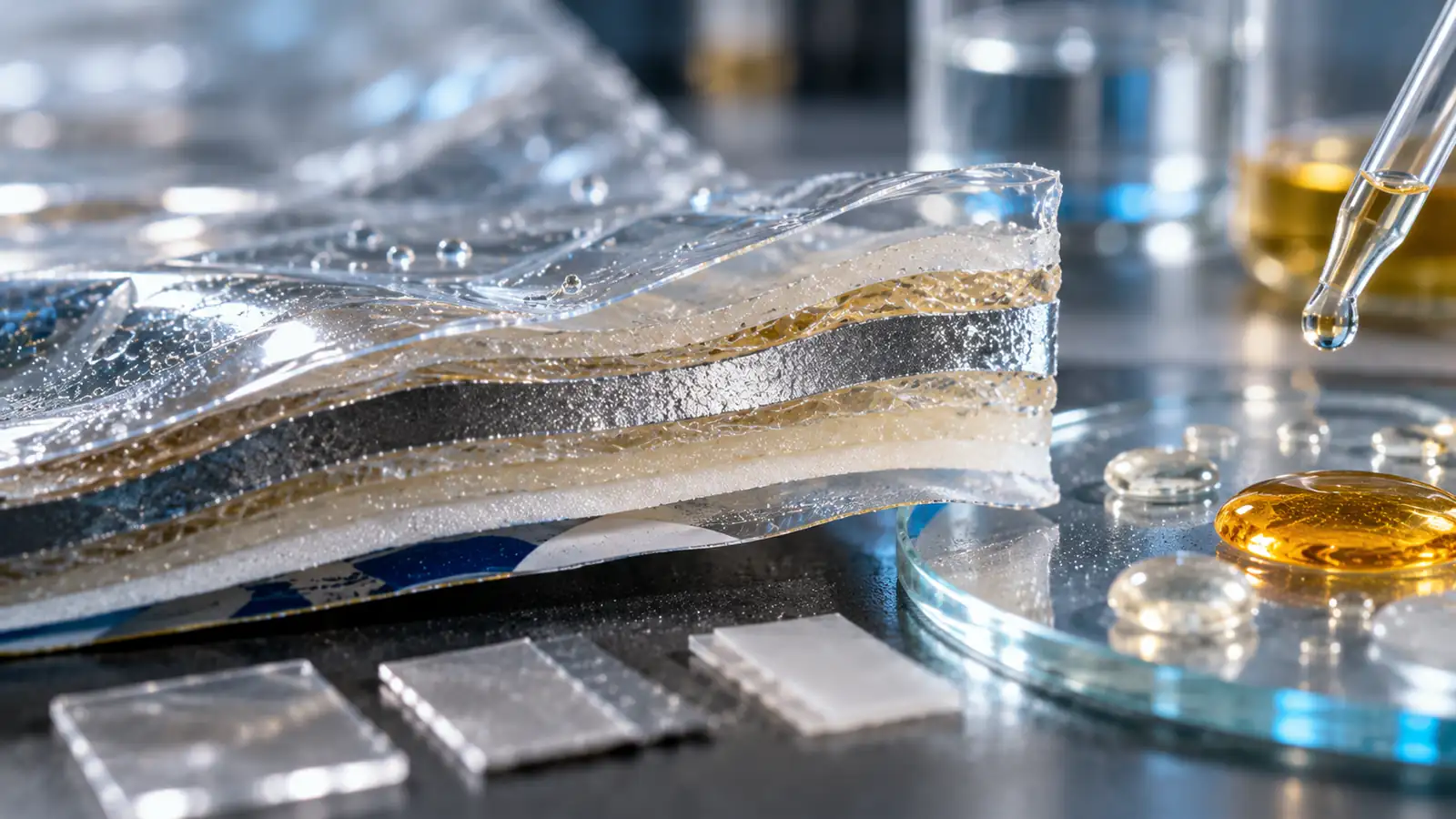
Two pouches can look virtually identical while using different polymers, coatings, adhesives, inks or laminate structures.
A material also cannot automatically be assumed to suit every application.
Technical food-contact guidance from the US FDA demonstrates why food type, temperature and contact duration matter. Its evaluation framework distinguishes aqueous, acidic and fatty foods alongside different use conditions including hot filling, refrigeration, freezing and reheating.
The business lesson is straightforward:
“Food grade” should not be the end of the conversation.
The next question is:
Food grade for what food, under what conditions?
A Supplier Change Can Become a System Change
Consider a chilli-sauce manufacturer changing pouch suppliers to reduce costs.
The dimensions remain the same.
The artwork is unchanged.
The customer sees no difference.
If the material structure, adhesive, coating or food-contact layer changes, however, quality assurance may be dealing with a technically different system.
The same principle applies to cups, lids, caps, trays, films and recycled-content materials.
Packaging changes therefore deserve change control, not only a procurement decision.
The business needs to know what changed, whether technical specifications remain equivalent, whether the intended conditions of use are still supported, and whether additional evidence or validation is required.
A modest price change can accompany a much more significant material change.
The 2026 Regulation Expands the Packaging Landscape
BPOM says the number of regulated plastic packaging material types increased from 41 to 58, while another 88 permitted food-contact substances were added following safety evaluation. The regulation also provides a clearer framework for reusable and recycled packaging.
BPOM has also tightened the migration limit for Bisphenol A in polycarbonate packaging through a phased implementation that ultimately reaches 0.05 mg/kg in the fifth year.
BPA is a useful example but should not become the entire packaging discussion.
The broader lesson is that packaging requirements evolve as material science, technology and risk assessment evolve.
A specification accepted in the past should not automatically be considered the end of future assessment.
Sustainable Does Not Automatically Mean Safe
Reusable and recycled packaging are increasingly attractive as businesses reduce virgin-material use.
The 2026 BPOM framework accommodates both, while maintaining that reusable and recycled packaging must continue satisfying safety requirements including migration limits and good manufacturing practices.
This distinction matters.
Sustainability solves one set of problems.
Food safety solves another.
More circular packaging still has to be safe for its intended food-contact conditions.
Good packaging design increasingly needs to optimise both.
Specifications Matter More Than Material Names
Small food businesses often purchase packaging using simple descriptions: PET, PP, paper cup, food-grade plastic, aluminium pouch.
Those labels are useful.
They do not describe the complete system.
What is the layer structure?
Which surface touches the food?
How thick is it?
How long is the contact?
Will it be hot filled?
Is the food acidic or fatty?
Will it be reheated?
Does a supplier switch change the formulation?
FDA guidance similarly illustrates that the safety status of food-contact articles depends on the substances making up the article and their intended conditions of use.
A material name alone therefore cannot communicate every relevant property.
Packaging Change Control
As a GATICORP editorial framework:
Food → Contact Condition → Material → Supplier Specification → Safety Evidence → Production Use → Change Control
It connects product development with procurement, quality assurance and regulatory work.
The framework is not an official BPOM procedure.
Its purpose is to prevent a common organisational problem: a packaging change that appears cosmetic to one team while being material to another.
Packaging Is Part of the Product
Customers rarely see adhesive systems, migration data or technical specifications.
They see the cup.
The bottle.
The pouch.
The tray.
Yet those invisible characteristics help determine whether the packaging performs safely.
BPOM's 2026 update reinforces a basic point: food safety does not stop at ingredients and manufacturing processes. Materials that contact the food also matter.
For food businesses, that means packaging should not be treated as an accessory surrounding the product.
Packaging is part of the product.
- BPOM Regulation No. 11 of 2026 on Food Packaging. Used for the regulatory scope, effective date, migration requirements and provisions for reusable and recycled packaging.
- BPOM, 24 August 2026 — New Food Packaging Regulation. Used for overall and specific migration and BPOM's food-safety framing.
- BPOM — 2026 Packaging Updates. Used for 58 regulated plastic material types, 88 additional food-contact substances and the phased BPA migration requirement.
- US FDA — Food Contact Substance Guidance. Used only as international technical context for food type, temperature and duration of contact. FDA requirements are not Indonesian law.
- Editorial note: not every packaging change requires the same assessment or testing. The appropriate requirement depends on the material, intended use, supplier evidence, type of change and applicable regulations. The GATICORP framework is an editorial decision tool rather than an official BPOM procedure.
Published: October 21, 2026