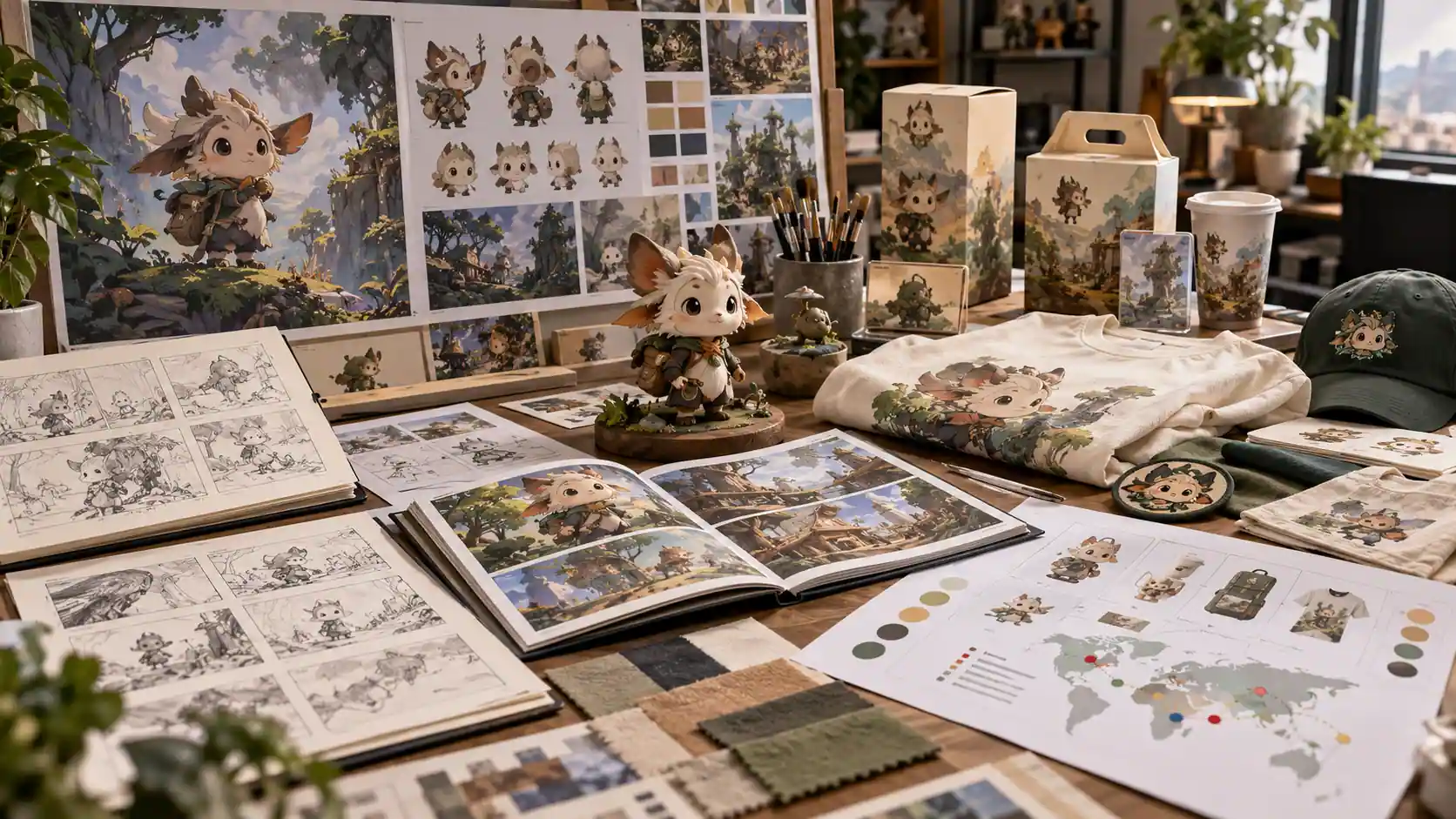

At Jakarta Futura Connectiva 2026, Indonesia's Ministry of Trade facilitated 38 IP-based creative businesses: 19 comic businesses, 15 animation businesses and four game businesses. The 3–4 October event recorded potential transactions of approximately US$195,965, or IDR3.51 billion, arising from business matching, prospective collaborations and retail sales. The ministry highlighted opportunities to extend individual IP into animation, games, comics, merchandise, publishing, licensing and co-production.
The important word is potential.
IDR3.51 billion does not mean that the entire amount has already become realised revenue. Business matching may continue into negotiation, licensing, co-production, distribution or investment—or never close.
The process nevertheless illustrates an important shift in how creative businesses can think about value.
Value is not only embedded in the work already produced.
It may also exist in the rights to develop that work further.
Content and IP Are Not the Same Thing
An illustration can be content.
A character can build an audience.
A story can go viral.
Popularity alone, however, does not automatically create a scalable business asset.
Structure begins when a business can answer who owns the rights, what is protected, who may use it, for what purpose, in which territory, for how long and in return for what.
WIPO describes IP commercialisation as going beyond protection toward commercial actions that generate value. Licensing is one route: the IP owner retains ownership while granting another party permission to use the asset according to agreed scope, geographic limits, duration and compensation.
That distinction changes the commercial possibilities.
A creator does not necessarily need to manufacture every product themselves to generate value from an IP.
They can allow others to do so under controlled rights.
One Character Can Support Several Businesses
Imagine a fictional character first becoming known through a webcomic.
The same character may later appear in short animation.
A publisher may want a book.
An apparel brand could propose a limited collection.
A toy company sees a collectible opportunity.
An F&B brand wants a seasonal collaboration.
A game developer wants the character as playable content.
Creatively, all of these applications originate from the same character.
Commercially, they may represent very different rights and transactions.
WIPO has described character merchandising as the commercial use of real or fictional characters in connection with goods and services. The licence may be extremely narrow—for example, one character name on one merchandise category in one country—or broad enough to cover multiple character elements, product categories and territories.
“Licensing a character” is therefore not one universal permission.
Rights can be divided.
Do Not Give Away More Rights Than Necessary
This is one of the most important principles in licensing.
If a company only needs a character for apparel in Indonesia for two years, an IP owner should ask why it needs to grant worldwide exclusivity across every product category for ten years.
WIPO recommends clearly defining what IP is licensed, how it can be used, the field or product category, market or territory, duration and rights such as manufacturing, selling or sublicensing. Compensation can take the form of an upfront payment, royalties based on sales or profit, access to distribution or manufacturing, or a combination.
Licences can also be exclusive, sole or non-exclusive.
Those structures carry economic consequences.
The broader the exclusivity granted, the more future commercial options the IP owner may be giving up.
IP monetisation therefore is not only about asking:
“What is the royalty rate?”
It is also about asking:
“Which rights are actually being granted?”
Clean Ownership Comes Before Scale
Creative properties are often built by many people.
A character designer creates the visual form.
A writer develops the story.
A freelance illustrator produces key art.
An animator creates motion.
A musician writes a soundtrack.
An agency develops a campaign.
A production house creates an adaptation.
Without clear documentation, ownership questions can become increasingly complicated once the property starts gaining value.
WIPO stresses the importance of establishing ownership and the rights necessary for commercialisation when work involves employees, consultants, collaborators or suppliers. Contracts should clarify what IP is owned, assigned or merely licensed for use.
Asset building therefore should begin before an IP becomes famous.
Ownership is easier to clarify while relationships are simple than after five commercial partners are already asking to use the work.
Licensing Does Not Mean Losing Control
IP owners may reasonably worry that licensing will dilute the property.
A partner may produce poor merchandise.
Colours can drift.
Packaging may feel wrong.
A character could appear in contexts that damage its reputation.
Quality control therefore forms an important part of commercialisation.
WIPO identifies quality guidelines, audit rights, dispute mechanisms and usage restrictions as tools that can help protect the owner. In trademark licensing, control over product quality and how goods are marketed is also important to protect the function and reputation associated with the mark.
Good licensing is therefore not simply sending artwork files to a partner and waiting for royalties.
It needs governance.
Who approves the design?
How many revision rounds exist?
Which materials can be used?
Can the licensee create derivative artwork?
Can it sublicense?
What happens to unsold inventory after the licence ends?
Questions like these determine whether expansion builds value or gradually erodes it.
Indonesia Already Has Commercialisation Infrastructure
Indonesia's Directorate General of Intellectual Property operates an IP Marketplace designed to connect IP owners and users and facilitate potential assignments, licensing, royalties and other business collaborations. DJKI itself does not directly participate in commercial negotiations between the parties.
Indonesia also has Government Regulation No. 36 of 2018 governing the recordation of IP licensing agreements across areas including copyright and related rights, patents, trademarks, industrial designs, integrated-circuit layout designs and trade secrets.
This highlights the distinction between owning IP and managing IP as a business asset.
Protection is a foundation.
Commercialisation is another layer.
From Creative Work to Asset Architecture
As an editorial framework, GATICORP views the journey as:
Creation → Ownership → Protection → Audience → Licensing Readiness → Commercialisation → Extension
Creation produces the work.
Ownership determines who controls the rights.
Protection strengthens the legal position appropriate to the type of IP.
Audience creates recognition and potential demand.
Licensing Readiness defines rights, territories, categories, approval processes and economics.
Commercialisation turns those rights into transactions.
Extension moves the property into new formats, products and partnerships without losing its core identity.
The process is not always linear.
A property can attract licensing before it has a huge audience. A famous IP does not automatically make sense in every product category.
The framework simply helps distinguish two questions:
“Do people like this work?”
and
“Does this work have the structure to generate value repeatedly?”
IP Changes How Businesses Think About Creativity
Content-based businesses often need continuous new output.
The next post.
The next episode.
The next campaign.
IP can create a different possibility.
One creative property may have a longer economic life because the same asset can operate across products, formats, territories and partners—provided that the owner actually holds the necessary rights and manages those uses carefully.
Creators and brands that begin building recognised characters, story worlds, signature designs, illustration languages or other creative properties may therefore need to start thinking as asset owners.
Not every work needs to become a franchise.
But when outside demand begins to appear, the question is no longer only:
“What should we create next?”
It becomes:
“What exactly do we own, and how can the value of this asset grow without losing control of it?”
That is the point at which creativity begins to move from output into a business asset.
- Indonesia Ministry of Trade — Jakarta Futura Connectiva 2026. The ministry facilitated 38 creative-industry businesses: 19 comics, 15 animation and four games. The 3–4 October event recorded approximately US$195,965 or IDR3.51 billion in potential transactions through business matching, prospective collaborations and retail sales. This figure is not presented as fully realised revenue.
- WIPO — Intellectual Property Commercialization. Used for the distinction between licensing and assignment and the principle that licensing allows the owner to retain ownership while granting usage rights within defined scope, territory, duration and compensation.
- WIPO — Earn by Generating Value from Your IP. Used for core licensing considerations including the IP being granted, product or field of use, market or territory, duration, rights, lump-sum payments, royalties, quality guidelines, audit rights and exclusive versus non-exclusive licensing.
- WIPO — Character Merchandising. Used to explain how characters can be commercialised across products and territories and how licence scope can range from very narrow to broad.
- WIPO — Key IP Considerations for Smaller Enterprises and Supplier IP Agreements. Used for the importance of clear ownership in collaborations, outsourced work and relationships involving employees, consultants and suppliers, as well as securing rights necessary for commercialisation.
- DJKI — IP Marketplace. The platform is designed to connect IP owners and users for potential assignments, licensing, royalties and other business collaboration. DJKI does not directly participate in commercial negotiations.
- Government Regulation No. 36 of 2018 on Recordation of Intellectual Property Licensing Agreements. Used as the Indonesian regulatory context for recording IP licensing arrangements.
- Creation → Ownership → Protection → Audience → Licensing Readiness → Commercialisation → Extension is a GATICORP editorial framework, not an official framework of the Ministry of Trade, DJKI or WIPO.
- This article does not suggest that every creative IP should be licensed or developed into a franchise. Commercial viability depends on demand, ownership, type of IP, available protection, partners, execution quality and the owner's business strategy.
- This article is intended for business education and does not constitute legal advice or a licensing agreement for a specific transaction.
Published: October 14, 2026