
On 17 August, 306 people gathered wearing Indonesian woven textiles—from songket and lurik to endek, ulos and ikat—and established a new Guinness World Records title.[1]
The record generated attention.
For the creative industry, however, the longer-lasting question begins after the attention fades.
How can traditional textiles become part of a modern brand without erasing the provenance that gives them meaning?
The question has commercial weight. Indonesia's Ministry of Creative Economy says fashion contributed 14.77% of creative-economy GDP in 2025 and accounted for 58.55% of creative-economy exports from January to April 2026.[2]
Culture and commerce are increasingly meeting in the same market.
Local identity is more than a motif
The quickest way to make a product appear locally rooted is to place a traditional-looking pattern on it and describe the collection as “inspired by Indonesia.”
Speed, however, is not the same as depth.
Ulos, songket, lurik, endek and different forms of ikat come from different regions, techniques, histories and communities.
Reducing them to one visual category can remove precisely what makes each tradition distinctive.
Indonesian copyright law also gives cultural context legal significance. Article 38 of the Copyright Law states that the use of traditional cultural expressions must take into account the values held by the communities that maintain them.[3] The explanatory text refers to customary practices, customary-law norms, social norms and other values upheld by communities of origin.
For brands, the principle is straightforward:
understand before interpreting.
Modern does not have to mean culturally diluted
Modernising a textile product does not necessarily require turning a traditional motif into something almost unrecognisable.
New value can be created elsewhere.
Better cuts.
More practical sizing.
Greater everyday usability.
Improved finishing.
A stronger combination of materials.
Better packaging.
Or distribution that places the product in front of a new customer.
This is the difference between design transformation and simply decorating a new product with cultural identity.
Designers still have substantial creative freedom. But strong design can usually explain what comes from an established tradition and what is genuinely new in the contemporary product.
Indonesia's intellectual-property authority made a similar distinction in January 2026, separating newly created original motifs from traditional motifs that have existed communally over generations.[4]
That distinction matters for brand storytelling.
Makers belong in the value chain
Traditional-textile marketing can sometimes reduce artisans to an emotional background story:
“carefully made by local craftspeople.”
That sounds respectful, but it does not necessarily describe the business relationship.
An artisan is a skilled producer.
There are technical capabilities, production times, capacity constraints, quality standards, prices and material knowledge involved.
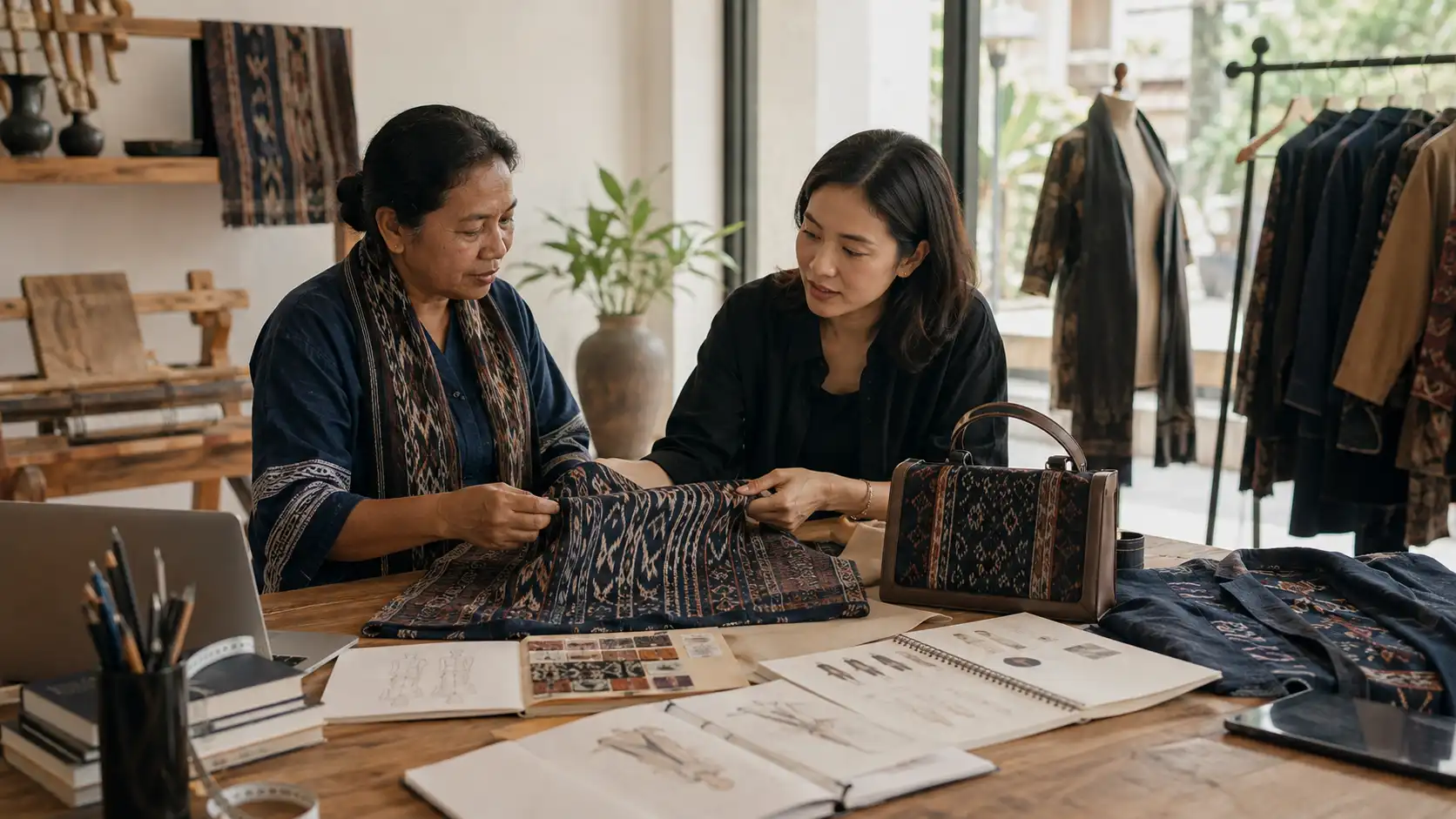
A brand building around traditional textiles should therefore treat makers as part of product development and the supply chain.
Who produces the material?
What is the realistic lead time?
How consistent are size and colour?
How much can be produced?
Can a proposed design actually be executed with the technique?
And how is economic value distributed along the production chain?
Those questions treat craftsmanship as business capability rather than marketing decoration.
Brand stories need evidence
Provenance can be a powerful brand asset.
Customers may genuinely value knowing where a textile comes from, how it is produced, who makes it or what distinguishes a particular technique.
But a compelling story still needs to be accurate.
A brand does not need to invent cultural mythology to make a product feel more exclusive.
If a motif carries a specific meaning, the claim should come from a credible source.
When that meaning cannot be established confidently, it may be better to explain the technique, region or craftsmanship that can be verified rather than add an attractive but unsupported story.
This becomes even more important in international markets.
Authenticity requires evidence, not only aesthetics.
Cultural identity does not have to limit marketability
A culturally rooted product still needs to perform the basic work of any commercial product.
It needs to be comfortable.
Functional.
Consistent.
Appropriately priced for its intended customer.
And easy to understand.
Indonesia's Ministry of Creative Economy has also been supporting community-based fashion networks and wider market access. In August, for example, it discussed Folkacommunal's plans for community-fashion activities in Indonesia, Malaysia and Singapore.[5]
Reaching a wider market does not require a brand to strip away its local identity to look more “global.”
It requires translation.
A customer in another country—or even another part of Indonesia—may not know the full context of a textile.
The brand's role is to make that context accessible without making it generic.
Five questions before building a textile-based brand
As a GATICORP editorial framework, five questions can help brands test how deeply cultural identity is embedded in a product strategy.
1. Origin
Do we know where the textile, motif or technique comes from?
2. Context
Are there meanings, practices or boundaries that should be understood before adapting it?
3. Maker
Who produces the material, and how are those makers positioned within the value chain?
4. Transformation
What new value is the brand genuinely adding—function, form, finishing, usability, distribution or product experience?
5. Attribution
Does the customer receive accurate information about provenance and the people involved?
This is not a legal standard or government guideline.
It is a way to test whether cultural branding has substance beyond its visual language.
Modern brands need roots and relevance
WIPO describes traditional cultural expressions as part of the identity and heritage of communities, carrying knowledge and skills passed through generations.[6]
Respecting that identity does not mean freezing culture in place.
Fashion changes.
Design interprets.
Customers evolve.
The challenge is to create new value without removing the provenance that created the value in the first place.
For Indonesian brands, traditional textiles offer something that marketing alone cannot manufacture: material, technique, story and identity that existed long before a contemporary brand was formed.
That opportunity also carries responsibility.
A strong brand should be able to move beyond saying:
“We use Indonesian culture.”
It should be able to explain:
which culture, where it comes from, who made it, what the brand changed, and what new value it created.
At that point, local identity stops being an ornament.
It becomes part of brand strategy.
- [1] Indonesia Ministry of Creative Economy / Creative Economy Agency. Ministry of Creative Economy Achieves Guinness World Records through Indonesian Woven Textiles. 17 August 2026. The ministry reported 306 participants against a minimum requirement of 250.
- [2] Indonesia Ministry of Creative Economy / Creative Economy Agency. Strengthening National Competitiveness, Ministry of Creative Economy Supports Indonesia Fashion Week 2026. 2 July 2026. Reports fashion at 14.77% of creative-economy GDP in 2025 and 58.55% of creative-economy exports in January–April 2026.
- [3] Republic of Indonesia / Directorate General of Intellectual Property. Law No. 28/2014 on Copyright, particularly Article 38 on Traditional Cultural Expressions.
- [4] Directorate General of Intellectual Property. Understanding the Difference Between Copyright, Industrial Design, Traditional Cultural Expressions and Geographical Indications in Woven Motifs. 12 January 2026. Distinguishes newly created original motifs from communally held traditional motifs.
- [5] Indonesia Ministry of Creative Economy / Creative Economy Agency. Deputy Minister Applauds Folkacommunal, Invites Gen Z to Embrace Indonesian Traditional Textiles. 10 August 2026.
- [6] World Intellectual Property Organization. Traditional Cultural Expressions. Provides international background on traditional cultural expressions as part of community identity, heritage, knowledge and skills.
- The Guinness record is used as a current editorial entry point, not as evidence of rising commercial demand for traditional textiles.
- The 14.77% figure refers to fashion's share of creative-economy GDP, not Indonesia's total GDP.
- The 58.55% figure refers to fashion's share of creative-economy exports for January–April 2026, not all Indonesian exports.
- Ulos, songket, lurik, endek and ikat are not treated as interchangeable cultural traditions.
- The article does not claim that all traditional textiles or motifs are sacred.
- It does not claim that every commercial adaptation of traditional motifs is automatically illegal or constitutes cultural appropriation.
- Article 38 is used narrowly and accurately: the use of traditional cultural expressions must take into account the values of the communities that maintain them.
- Newly created original motifs and communally held traditional motifs are distinguished using DJKI's 2026 explanation.
- No claim is made that using traditional textiles automatically makes a brand authentic, premium, more expensive or commercially successful.
- Origin → Context → Maker → Transformation → Attribution is a GATICORP editorial framework, not a legal standard.
- This article does not provide an IP opinion on any particular textile, motif, brand or product.
Published: August 23, 2026