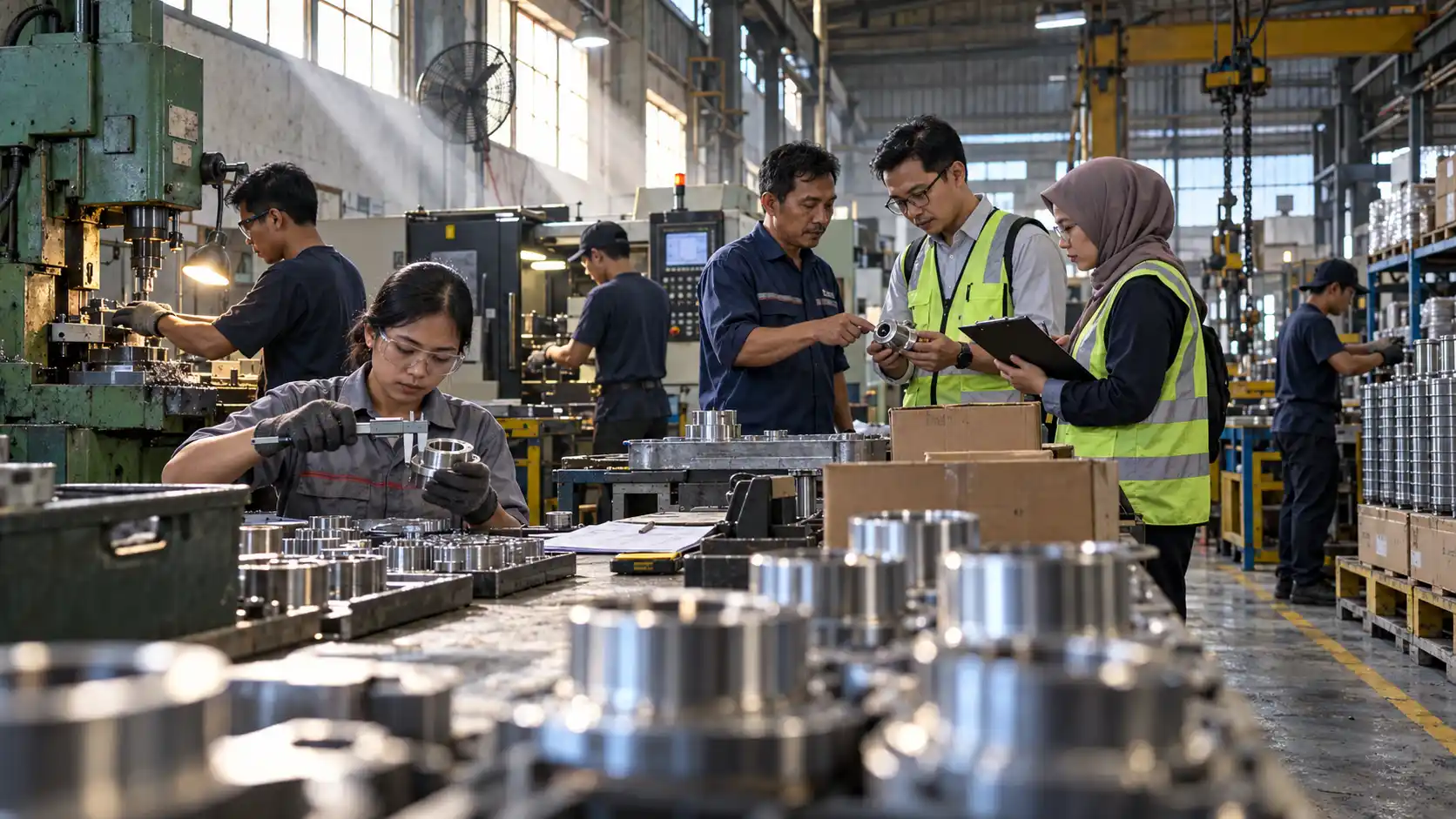

One number looks particularly encouraging as Indonesia marks its 81st Independence Day.
Investment realisation reached Rp1.0106 quadrillion in the first half of 2026, up 7.2% year on year. BKPM says the investment directly absorbed 1,448,862 Indonesian workers, 15% more than a year earlier.[1]
That matters.
But for household economics, the next question matters even more:
what kind of jobs are being created?
More people working is progress
Indonesia’s labour-market data show improvement.
BPS recorded 147.67 million people employed in February 2026, around 1.896 million more than a year earlier. The unemployment rate declined from 4.76% to 4.68%.[2]
The BKPM and BPS numbers, however, should not be matched directly.
BKPM measures direct employment associated with investment realisation within its reporting scope. BPS uses the national labour-force survey to measure the overall labour market.
They answer different questions.
It would therefore be incorrect to claim that BKPM’s 1.45 million jobs explain a specific portion of the increase in national employment.
Job numbers do not fully describe job quality
Unemployment receives attention because it is intuitive.
But employment is not simply a binary condition.
BPS reported that 66.77% of workers were full-time in February 2026, up from 66.19% a year earlier. Part-time workers accounted for 25.97%, while underemployment stood at 7.27%.[3]
The average employee wage was Rp3.29 million per month.[2]
That figure also requires precision. It is the average wage of employees, not the income of all 147.67 million employed Indonesians.
For a household, job quality is eventually experienced through income, working hours, stability, protection, learning opportunities and the possibility of moving forward.
High-quality investment needs productive jobs
Investment can build factories, machinery, logistics networks, data centres, industrial estates and production capacity.
Its long-term impact becomes stronger when it also improves worker productivity.
A technology-intensive investment may employ fewer people per unit of output. That is not automatically negative if the jobs created are more productive, require higher skills and support better incomes.
Conversely, an investment that generates many low-productivity jobs without skill development has a different economic impact.
Investment performance therefore needs at least two lenses:
how many jobs are created, and how productive those jobs become.
The World Bank is emphasising “better jobs”
The World Bank said in June that productivity reforms are important for creating more and better jobs, while highlighting the importance of business demand for higher-skilled and higher-paid work.[4]
That message matters for companies.
Businesses are not merely beneficiaries of investment policy. They are where investment is converted into employment.
Decisions about training, technology, career development, safety, productivity and compensation influence whether new capital ultimately strengthens the workforce.
There is also a clear commercial interest.
More productive workers allow companies to create greater value without competing primarily on cheap labour.
Avoid the misleading “cost per job” calculation
It can be tempting to divide Rp1.0106 quadrillion by 1,448,862 workers and describe the result as the cost of creating one job.
That would be misleading.
Investment pays for machinery, land, technology, buildings, infrastructure and capacity that may operate for years. Some projects are highly labour-intensive; others require heavy capital investment.
An investment-to-job ratio is meaningful only with proper sectoral and methodological context.
The better question is whether investment raises output, productivity and sustainable economic opportunity.
What should companies measure?
Companies expanding their operations can look beyond headcount.
Useful questions include:
Is output per worker increasing?
Are workers acquiring new skills?
Is employee turnover improving?
Is workplace safety strengthening?
Are incomes developing alongside productivity?
Is there a credible career path?
These are not solely social questions.
They are competitive questions.
An economy that wants to move up the value chain requires companies capable of producing higher-value goods and services. Those companies, in turn, require a workforce with stronger capabilities.
Investment matters when people move up too
Rp1.0106 quadrillion in investment is significant.
So is declining unemployment.
But economic success does not end when capital enters the country and someone gets a job.
The harder stage comes next:
making that work productive enough to improve workers’ lives and competitive enough to strengthen the company employing them.
On Independence Day, economic self-reliance can also be understood through that lens.
Not only by how much capital Indonesia can attract.
But by how effectively that capital can be transformed into skills, productivity, income and opportunity for the people whose work ultimately makes investment productive.
- [1] Kementerian Investasi dan Hilirisasi/BKPM. Realisasi Investasi Semester I 2026 Tembus Rp1.010 T, Serap 1,4 Juta Tenaga Kerja Langsung. 17 July 2026.
- [2] Badan Pusat Statistik. Tingkat Pengangguran Terbuka sebesar 4,68 persen. Rata-rata upah buruh sebesar Rp3,29 juta. 5 May 2026.
- [3] Badan Pusat Statistik. Ringkasan ketenagakerjaan Februari 2026: pekerja penuh 66,77%, paruh waktu 25,97%, setengah pengangguran 7,27%. May 2026.
- [4] World Bank. Indonesia’s Growth Remains Resilient, but Productivity Reforms Are Key to Creating Jobs and Sustaining Momentum. 13 June 2026.
- Data tenaga kerja BKPM dan Sakernas BPS mempunyai scope berbeda dan tidak dibandingkan secara satu banding satu.
- Rp3,29 juta adalah rata-rata upah buruh, bukan seluruh orang bekerja.
- Artikel tidak menghitung investasi dibagi pekerjaan sebagai “cost per job”.
- Job quality dibahas melalui produktivitas, jam kerja, skill, pendapatan dan prospek, bukan satu indikator tunggal.
- Tidak ada klaim bahwa investasi otomatis menyebabkan seluruh perbaikan pasar tenaga kerja.
Published: August 17, 2026