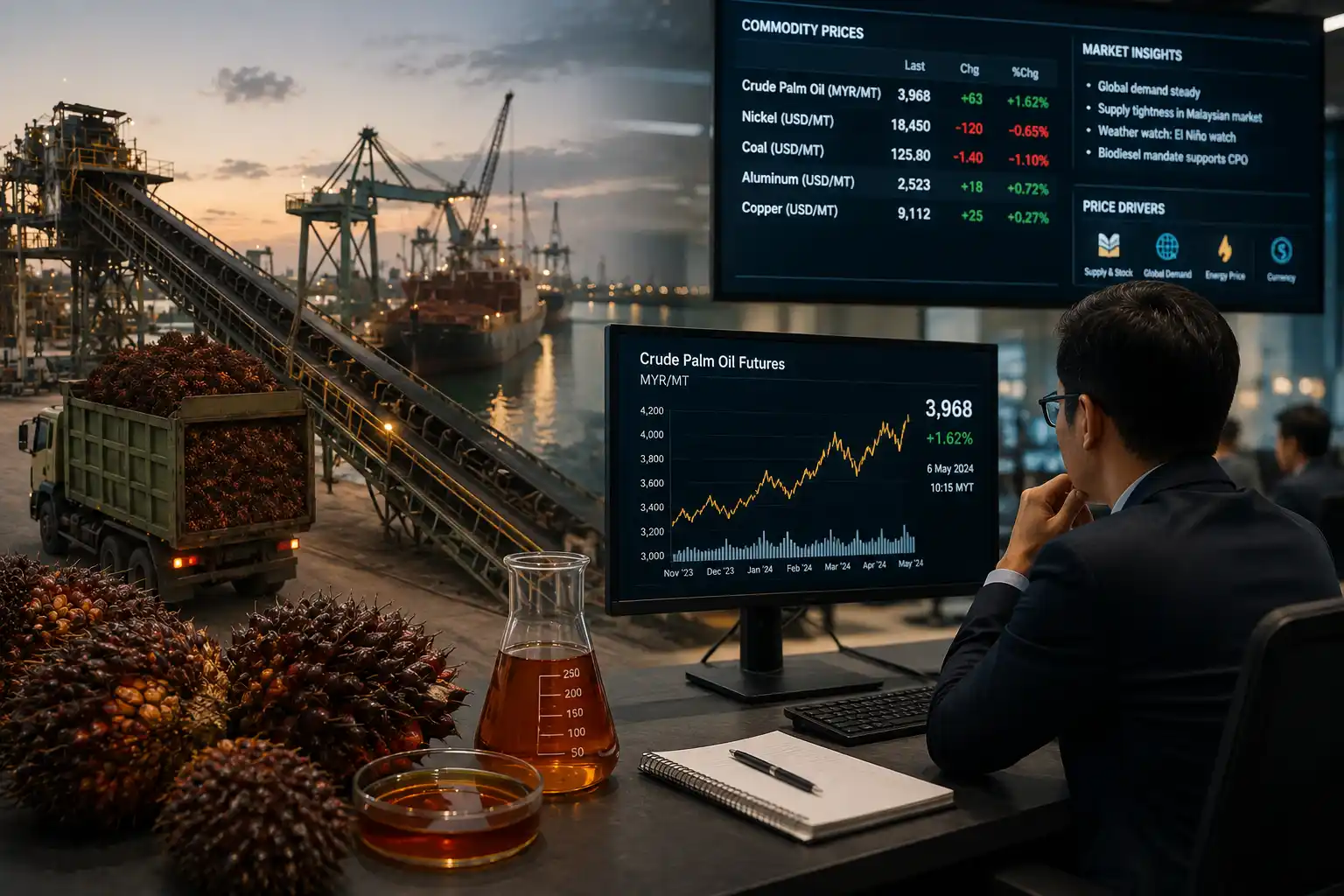

Indonesia is a major global producer of several commodities. But being a major producer and being the market where prices are discovered are two different things.
The government now wants to narrow that gap.
President Prabowo has announced plans for a new strategic commodity exchange, targeted to begin operating by 1 January 2027. Reuters reports that OJK will oversee the exchange, with initial rules expected by 17 September 2026.[1]
The objective is to give Indonesia a greater role in the formation of prices for commodities that have often relied on benchmarks established elsewhere.
Creating an exchange, however, is only the first step.
Being a major producer does not automatically create a benchmark
Indonesia holds important positions in palm oil, nickel, coal, tin and other resources.
But global benchmarks generally emerge from markets where trading activity is substantial, participants are diverse, information is trusted, and contracts and settlement mechanisms can be used consistently.
UNCTAD describes commodity exchanges as institutions that can support price discovery, risk management, market information and trade facilitation.[5]
An exchange therefore needs to do more than publish a price.
It needs buyers and sellers to discover that price through transactions.
The more widely the market is actually used, the more relevant its price signal can become.
A benchmark requires real transactions
A benchmark becomes stronger when there is enough trading to reflect market conditions.
Imagine a price built from only a handful of trades.
One unusually large order could move the market disproportionately.
A deeper market involving producers, traders, buyers, hedgers and financial participants can incorporate more information.
That means one of the most important measures after launch will not simply be how many companies register.
It will be:
how much genuine trading takes place and who participates.
Indonesia already has experience with commodity exchanges, including palm oil and tin. Reuters notes that trading on the palm-oil exchange launched in 2023 remains relatively light compared with more established regional benchmarks.[1]
That experience highlights the importance of liquidity and adoption.
Product transparency matters as much as price
Commodities are not always identical.
Mineral grades vary.
Palm-oil quality varies.
Ferroalloy specifications vary.
Delivery location, timing, logistics and contract terms can also change value.
A credible benchmark therefore needs clear definitions for grade, quality, delivery point, contract size and settlement.
If participants do not believe the quoted price represents comparable products, it becomes difficult to use that price in contracts.
For Indonesian businesses, standardisation could therefore become one of the most strategic benefits of the new system: not merely creating a number, but creating a more consistent trading language.
The new exchange comes alongside export reform
The exchange plan arrives while Indonesia is also restructuring commodity-export governance.
Government Regulation 24/2026 establishes a framework for strategic-resource exports, initially covering coal, palm oil and ferroalloys.[3] The government has also established PT Danantara Sumberdaya Indonesia to strengthen export oversight, trade data and foreign-exchange management.[4]
The two mechanisms should not be confused.
DSI relates to export governance.
The proposed exchange is aimed at price formation.
That distinction matters for exporters assessing how the policy landscape may change.
What could it mean for companies?
For producers and exporters, a trusted local benchmark could provide another reference point for contracts.
For buyers, transparent markets can make price and quality comparisons easier.
For traders, futures or derivative products—if they eventually develop—could expand tools for managing price risk.
For banks and financiers, a transparent benchmark could support valuation of inventory and commodity exposure.
But those outcomes depend on the final design and products available.
There is no basis yet for claiming exporters will automatically receive higher prices.
The purpose of a credible benchmark is not to make prices permanently higher.
It is to make price formation more representative and trusted.
Five things businesses should watch
Ahead of the 2027 target, companies should monitor five developments.
Commodities
Which resources will actually enter the first phase?
Market participants
Will participation include international buyers, traders and financial institutions as well as domestic producers?
Contract design
How will grade, delivery, settlement and reference pricing work?
Liquidity
Will there be enough transactions for prices to become representative?
Integration
How will the exchange interact with DSI, export rules, existing contracts and global benchmarks?
The answers will determine how significant the change becomes for businesses.
Benchmarks are built through trust
Indonesia begins with an important advantage: a large physical commodity base.
That creates a strong foundation for market development.
But international benchmarks become influential not simply because a commodity originates in one country.
They become influential because buyers, sellers, traders and investors repeatedly choose to use them.
Price influence is therefore built through liquidity, transparency, credibility and participation.
The proposed exchange creates an opportunity for Indonesia to strengthen those foundations.
Its eventual success will not be measured only by whether an exchange exists in 2027.
It will be measured by whether prices formed there are actually used by the market to trade, write contracts, manage risk and make business decisions.
- [1] Reuters. ‘Our resources, our prices’: Indonesia’s Prabowo announces new commodity bourse. 14 August 2026.
- [2] Sekretariat Negara Republik Indonesia. Di Hadapan DPR, Presiden Prabowo Serukan Perbaikan Sistem Ekonomi dan Penegakan Kedaulatan Nasional. 2026.
- [3] Sekretariat Negara Republik Indonesia. PP 24/2026 tentang Tata Kelola Ekspor Komoditas Sumber Daya Alam Strategis. 15 June 2026.
- [4] Kementerian Koordinator Bidang Perekonomian. Perkuat Tata Kelola Ekspor SDA, Pemerintah Matangkan Operasional PT Danantara Sumberdaya Indonesia. 31 May 2026.
- [5] UN Trade and Development (UNCTAD). Managing commodity price risk in commodity-dependent developing countries.
- Bursa baru adalah rencana, belum beroperasi.
- Target 1 Januari 2027 berasal dari pengumuman pemerintah yang dilaporkan Reuters.
- Detail komoditas yang masuk bursa belum lengkap.
- OJK disebut sebagai regulator; detail aturan masih ditunggu.
- DSI dan bursa komoditas diperlakukan sebagai mekanisme berbeda.
- Artikel tidak mengatakan Indonesia sudah menjadi global price-setter.
- Likuiditas, transparency, participation dan credibility digunakan sebagai kerangka analitis berdasarkan fungsi commodity exchanges yang dijelaskan UNCTAD.
- Tidak ada klaim bahwa benchmark domestik otomatis meningkatkan harga ekspor.
- Artikel bukan rekomendasi trading atau investasi komoditas.
Published: August 19, 2026