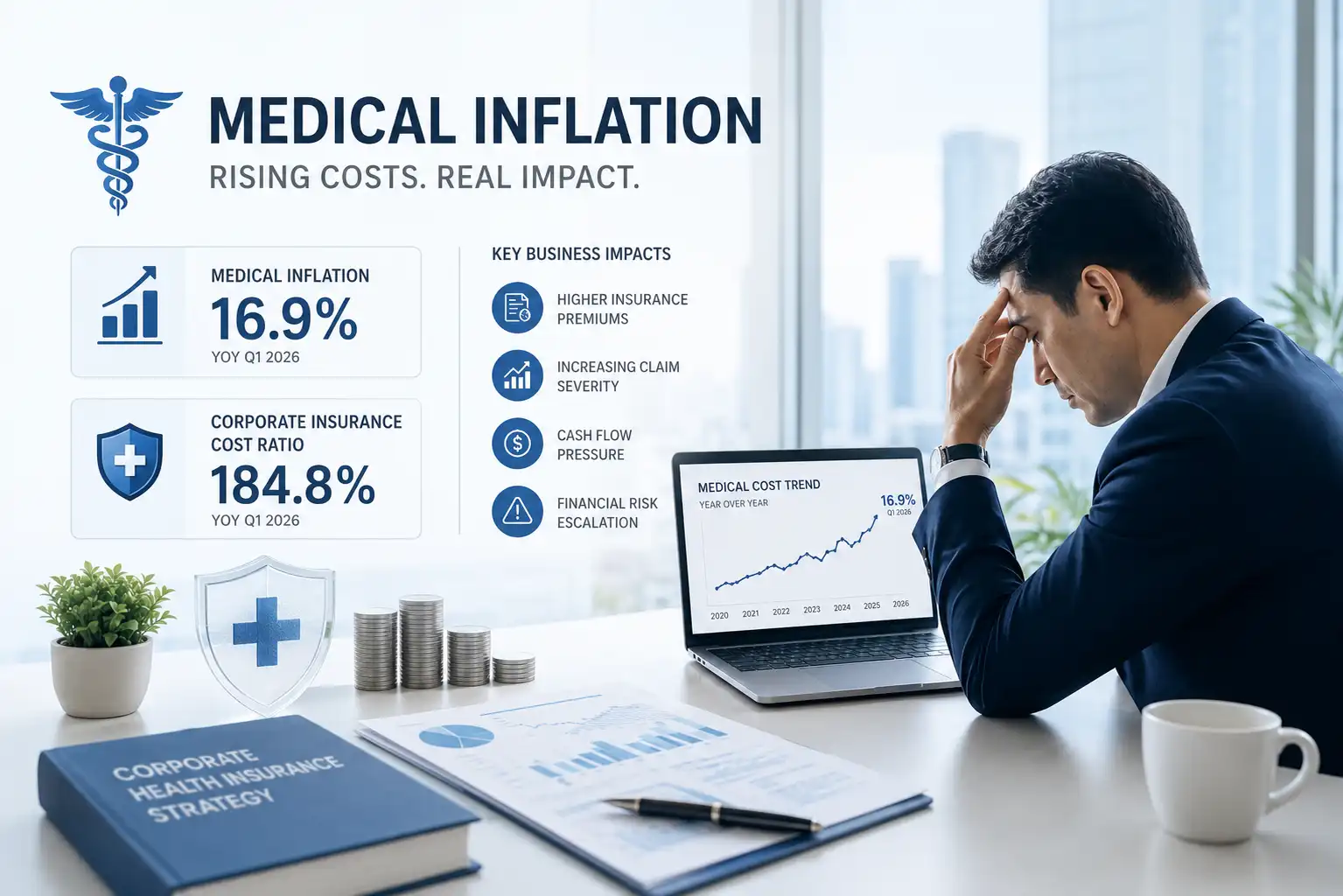

184.8%. That is the staggering loss ratio for individual health insurance claims during the first quarter of 2026. Reported by IFG Progress, this terrifying figure is far more than an abstract data point. It serves as a deafening warning siren for every business executive. The harsh reality is that medical inflation in Indonesia has aggressively skyrocketed to 16.9%. The financial burden of protecting your employees’ health is quietly engineering a hidden cash flow crisis for the modern corporate sector.
What Does This Number Mean?
When a health insurance loss ratio nears 185%, it indicates that insurance carriers are paying out claims at almost double the rate of the premiums they collect. The health insurance segment within the life insurance industry is under immense stress. Despite health insurance premiums reaching Rp 7.9 trillion in the first quarter of 2026, the volume of claims has already violently breached the Rp 6.1 trillion mark.
For business owners, this is an undeniable red flag. Insurers are bound to initiate massive repricing and premium adjustments merely to salvage their profitability. Without a tactical pivot in strategy, the escalating costs of employee benefits next year will ruthlessly erode your corporate profit margins.
Factors Driving High Medical Inflation
Why exactly are healthcare costs spiraling out of control? Three primary catalysts drive this surge. First, a massive leap in hospital utilization. Post-pandemic, the eagerness among the public—including your workforce—to seek medical consultation has soared remarkably. Second, the complex, long-term treatments for chronic diseases consume vast financial resources. Third, the rapid adoption of cutting-edge medical technology in private hospitals often translates directly into higher bills billed to the insurance.
Overall, the Financial Services Authority (OJK) notes that total assets within the Indonesian insurance industry still experienced a modest 2.87% year-on-year growth to Rp 1,197.04 trillion as of May 2026. Yet, this positive metric is heavily shadowed by claims inflating at a much faster pace, presenting a ticking time bomb for health portfolios.
Comparison: Medical vs. General Inflation
The statistical gap today is highly alarming. General inflation in Indonesia sits comfortably at a mild 2.5%. Concurrently, the medical trend rate stubbornly persists at a massive 16.9%. This staggering gap of over 14 percentage points solidifies Indonesia as one of the most critical zones in the region for healthcare expenses. What is rarely discussed is the cascading consequence on corporate budgets: if your employee insurance premiums are forced up by 15-20% at the next policy renewal, is your business cash flow genuinely prepared to handle it?
Practical Implications for Your Business
Providing employee insurance purely as an administrative retention checkbox is no longer an affordable tactic. Companies are strictly required to modernize how they approach their health protection coverage. Integrating tech-driven fraud detection, implementing calculated co-payment structures, and enforcing managed care models must become standard criteria when selecting an insurance partner.
You must collaborate with specialized corporate insurance agencies capable of interpreting your specific business risk portfolio, rather than settling for traditional agents peddling off-the-shelf, generic templates.
FAQ
- Why are my company’s employee insurance premiums projected to rise drastically in 2026? This spike is purely fueled by Indonesia’s 16.9% medical inflation and an exponential surge in health insurance loss ratios, which is aggressively forcing insurers to make significant tariff adjustments.
- What can SMEs or large corporations do to suppress these soaring costs? Focus exclusively on negotiating structured protection schemes. Evaluate past claim utilizations, employ a risk-sharing approach, and ensure you partner with certified corporate insurance experts to design highly targeted benefit packages.
- Is Indonesia’s insurance industry fundamentally healthy in 2026? In aggregate, yes. The Allianz Global Insurance Report (2026) points out that Indonesia's insurance sector is projected to maintain a robust 11% overall growth. However, the specific health insurance segment requires urgent business restructuring to remain sustainable.
Conclusion
The shocking figures of 16.9% and 184.8% are not just casual statistics to browse through. They act as an immediate call to action. The future financial efficiency of your enterprise depends entirely on how intelligently you orchestrate your employee health benefits today. Do not wait until soaring premiums suffocate your budget—it is time to conduct a thorough audit of your corporate insurance policies right now.
Sources:
- Katadata (2026) - Laporan Pertumbuhan Pasar Makanan Beku Indonesia Kuartal II. Diakses 21 Juli 2026.
- Bisnis.com (2026) - Analisis Preferensi Konsumen Terhadap Kemasan Vakum pada Produk UMKM. Diakses 21 Juli 2026.
- Statista & Euromonitor (2026) - F&B Industry Data Tracker for Southeast Asia. Diakses 21 Juli 2026.
Published: July 22, 2026
Source and editorial notes are managed through GATICORP CMS.