
There is a familiar moment in every food business.
A supplier sends a new price.
The owner opens a spreadsheet.
Food cost rises.
The immediate question becomes:
How much should we increase menu prices?
That question often comes too early.
Price is only one lever.
Portion, recipe, sourcing, waste, menu mix, bundling, and product design all matter.
Cost pressure is real—but uneven
Indonesia’s Producer Price Index for agriculture, forestry, and fishing increased 3.79% year on year in Q2 2026, while manufacturing producer prices increased 4.94%.[1]
Volatile-food inflation reached 4.06% year on year in August, with chicken, bird’s-eye chilli, and rice among the monthly contributors.[2]
Headline consumer inflation stood at 3.19%.[3]
None of these figures represents the food cost of every restaurant.
Menu composition, sourcing, location, and quality vary.
The response must therefore be specific.
Separate temporary from structural pressure
A chilli spike may reverse.
Rent is more structural.
Fuel can behave differently again.
Before changing prices, ask:
Is this increase temporary or persistent?
Temporary pressure may justify short-term absorption or sourcing changes.
Structural pressure may justify a redesign.
Contribution margin matters more than food-cost percentage alone
Traditional menu analysis often considers both popularity and contribution margin rather than relying only on food-cost percentage.[4][5]
More recent work shows that activity-based costing can improve menu profitability analysis by incorporating traceable operating costs.[6]
The better question is not:
“What percentage is food cost?”
It is:
“How much contribution does this item generate after relevant variable costs?”
Option 1 — Raise the price
A price increase is more defensible when cost pressure is structural, margins have become too thin, demand is strong, and the product has clear perceived value.
But not every menu item needs the same increase.
Blanket pricing is convenient.
Selective pricing is often smarter.
Option 2 — Reduce the portion
Portion changes are sensitive because customers experience them directly.
Research has found that smaller portions do not automatically reduce perceived value; the effect depends partly on perceived food quality and purchase intention.[7]
But shrinking portions without protecting perceived fairness can damage trust.
Recent research on restaurant consumer response during inflation also suggests reactions to price increases and shrinkflation depend on perceived sacrifice and empathy toward the business.[8]
Do not hide shrinkflation
Research in food retail has found that package downsizing raises effective unit prices and that clearer unit-price disclosure can change consumer behaviour.[9]
That study concerns US canned tuna, not Indonesian restaurants.
But the broader lesson is useful:
margin should not depend on customers failing to notice what changed.
Option 3 — Change the recipe
Sometimes the issue is one expensive component.
Can sourcing change?
Can a garnish be removed?
Can yield improve?
Can local alternatives work?
Can preparation reduce waste?
Recipe changes should be tested for quality and customer acceptance.
Option 4 — Change the menu mix
Menu engineering classifies items using measures such as popularity and contribution margin.[5]
The classic idea is simple:
high-popularity/high-margin items deserve different treatment from low-popularity/low-margin items.
More recent work also considers substitution between menu items because changing one item can shift demand to another.[10]
Option 5 — Fix waste before changing price
Over-portioning.
Spoilage.
Overproduction.
Incorrect preparation.
Returns.
These costs can be material.
A business should understand internal waste before assuming suppliers are the entire problem.
Portion control is also quality control
Standard portions create predictable costs.
They also create predictable customer experience.
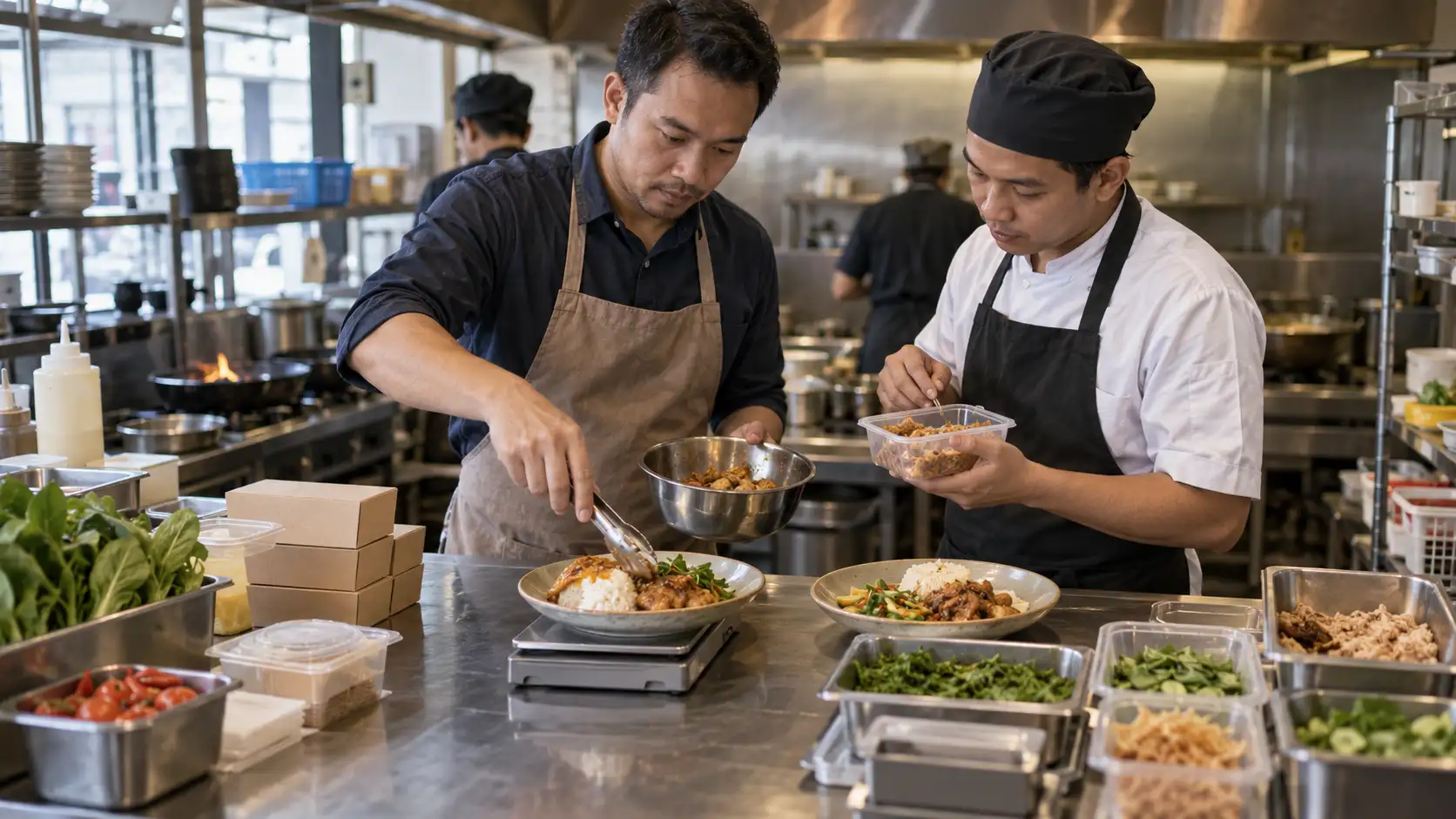
Scales, scoops, recipe cards, and plating standards reduce variance.
This is not about making portions smaller.
It is about making them consistent.
Use a decision tree
When an input rises:
Is the increase material?
Is it temporary?
Is the item still profitable?
Is the item popular?
Can sourcing or preparation improve?
Will the change damage perceived value?
Only after answering those questions should pricing become the default option.
Price is not simply cost plus margin
Customers do not see your spreadsheet.
They see value.
Price acceptance depends on brand, competition, quality, convenience, location, occasion, and alternatives.
A useful pricing decision therefore considers both:
cost floor and customer value ceiling.
Small businesses can experiment
SMEs do not need to redesign the entire menu at once.
Test one category.
Change two prices.
Adjust one portion.
Create one bundle.
Measure four weeks.
Track unit sales, gross margin, repeat purchase, complaints, and substitution.
Small experiments reduce risk.
Protect trust
Customers do not require a full cost breakdown.
But they do expect fairness.
If prices rise, experience should not deteriorate simultaneously.
If portions change, avoid creating a sense of deception.
If recipes change, maintain the promise customers came for.
Trust is an economic asset.
The better question
When food costs rise, the first question is often:
“How much should we raise prices?”
The better question is:
“What needs to change so customer value remains strong and contribution margin remains healthy?”
Sometimes the answer is price.
Sometimes it is portion.
Sometimes sourcing.
Sometimes recipe.
Sometimes the menu item itself.
Resilient F&B operators are not those that raise prices fastest.
They are the ones that understand fastest where their economics actually changed.
- [1] BPS. Producer Price Index Q2 2026.
- [2] Bank Indonesia. August 2026 volatile-food inflation.
- [3] BPS. August 2026 inflation.
- [4] Cost/margin analysis literature.
- [5] Menu engineering in Asian restaurants.
- [6] Menu engineering and activity-based costing.
- [7] Portion-size and perceived-value study.
- [8] Restaurant price increases and shrinkflation research, 2026.
- [9] Food Policy shrinkflation study, 2026.
- [10] Menu engineering and substitution research.
Published: September 6, 2026