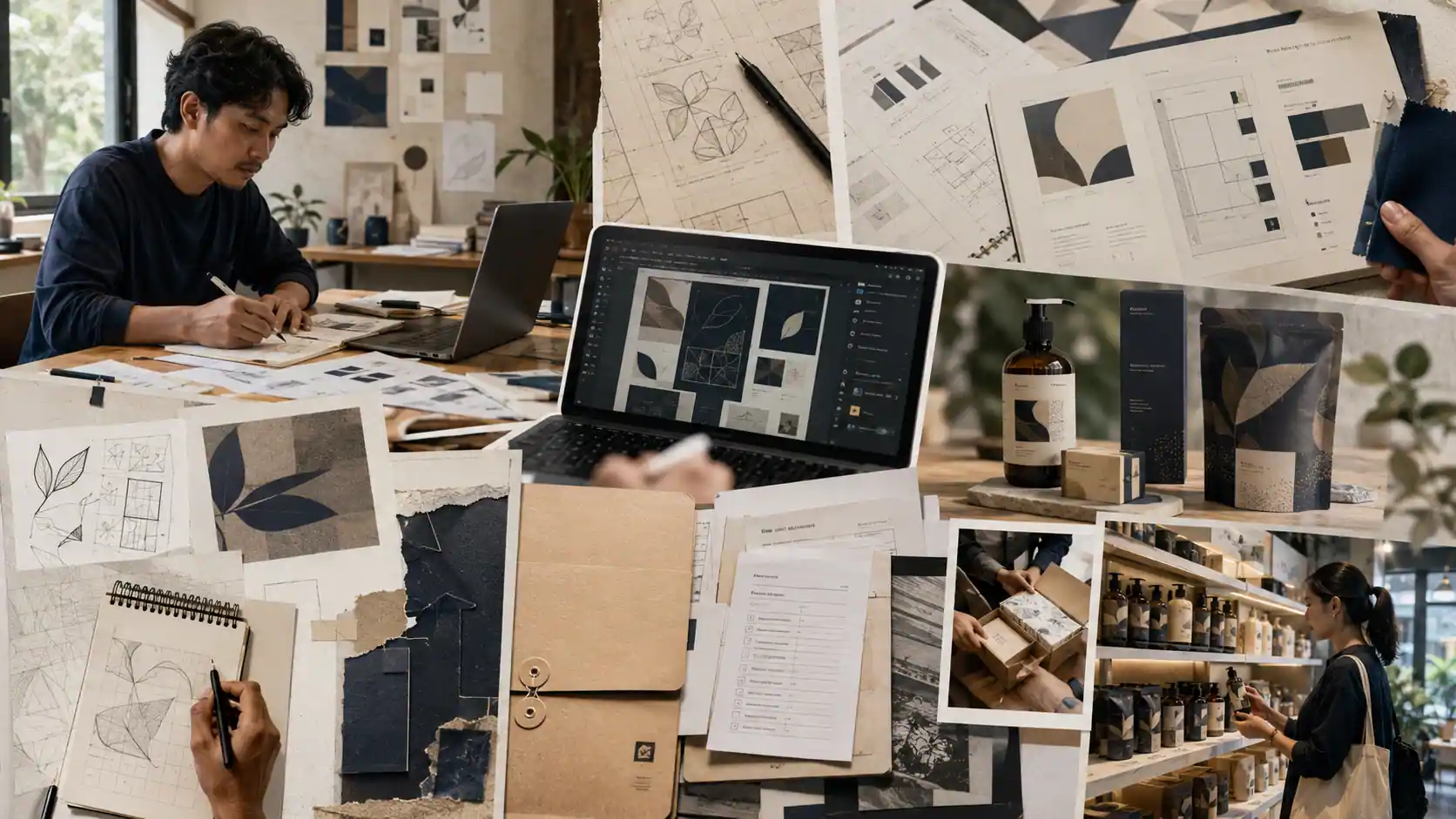

A designer completes a logo.
The files are delivered.
The invoice is paid.
The project ends.
There is nothing inherently wrong with that business model.
But it raises an interesting question:
Does the value of design have to end when the file is delivered?
At MODB 2026 in Jakarta, Indonesia's Ministry of Creative Economy argued that design capability increasingly extends beyond producing work that is attractive and functional. Designers also need systemic thinking, AI literacy, intellectual-property readiness, cultural intelligence and the ability to design for impact.[1]
A similar idea appeared days earlier at IdeaFriends, where creative work and intellectual property were discussed as potential sources of economic value through business models, licensing and collaboration.[2]
For the creative business, the question is not simply how to produce more work.
It is how the value created by one piece of work can outlive one project.
An output and a system have different lifespans
Imagine two designers receive a restaurant identity brief.
The first delivers:
a logo;
two colours;
final artwork.
The second creates:
identity principles;
a logo system;
typography;
colour hierarchy;
photography direction;
packaging logic;
signage rules;
social templates;
and usage guidelines.
Both produced design.
But the second result is easier to reuse, hand to another team, extend into new locations and maintain consistently.
The distinction is not simply the number of guideline pages.
It is system thinking.
An output solves today's need.
A system helps a business solve recurring needs.
A design asset is not automatically an accounting asset
The word “asset” deserves care.
In a creative-business conversation, work can be described as an asset because it has continuing usefulness or economic potential.
Under intellectual-property law, protection depends on the nature of the work and the relevant legal regime.
Under accounting standards, an item must meet specific criteria before it can be recognised as an asset.
Those are not the same thing.
A valuable corporate identity may not appear as a separately measured intangible asset on a balance sheet.
Conversely, something can have substantial strategic value to a brand without being assigned a standalone accounting value.
It is therefore safer to discuss business-asset value before making accounting claims.
Documentation makes creative work more usable
Creative work often loses value not because the design is weak but because nobody knows how it was built.
Source files disappear.
Font licensing is unclear.
Stock-image sources cannot be found.
Ownership is ambiguous.
New designers reverse-engineer decisions made by previous designers.
As a business grows, those small uncertainties become expensive.
Useful documentation can cover:
source assets;
usage guidelines;
font and image licences;
approval history;
AI tools used where relevant;
ownership agreements;
and final approved versions.
Documentation is not administration after the creativity is finished.
It allows creativity to survive beyond its original creator.
Intellectual property requires the right classification
The Ministry of Creative Economy now lists IP-readiness among the capabilities it wants designers to develop.[1]
But “register everything as IP” is not precise enough.
Different creative outputs can involve different rights:
copyright;
trademarks;
industrial designs;
trade secrets;
or contractual rights.
A single commercial product can involve several at once.
Creative teams therefore need to ask more than:
“Do we own this?”
They should ask:
“Which rights do we actually hold, how were they acquired, in which territories, for how long, and for which uses?”
That becomes especially important when work involves photographers, illustrators, fonts, stock assets, freelancers, agencies or AI-generated components.
AI makes production faster—and provenance more important
MODB 2026 also encouraged designers to use AI to accelerate processes without removing the human dimension of design.[1]
That productivity gain can be substantial.
Visual variations that once required hours can now be explored quickly.
Speed, however, creates new questions.
Where did the source material come from?
Which elements were AI-generated?
What was materially edited by a person?
Were third-party assets involved?
Who approved the final output?
What can the company legitimately claim as its own?
As creative production becomes more automated, provenance becomes more valuable.
Speed without documentation can produce many outputs and little certainty.
Reuse can be one of design's strongest sources of value
Large brands rarely recreate everything from zero each day.
They operate systems.
One digital component works across many pages.
One packaging architecture serves several SKUs.
One campaign system adapts across dozens of formats.
One illustration language can last for years.
One character can eventually become part of a licensing ecosystem.
The value comes from reuse without becoming repetitive.
This is where design systems meet business economics.
Every decision that does not need to be repeatedly reinvented can reduce coordination cost and improve consistency.
Licensing changes how creative work can earn
Some creative-business models do not require creators to sell complete ownership.
Photography can be licensed.
Illustrations can be licensed for defined uses.
Typefaces operate under licences.
Characters can appear on merchandise through agreements.
Creative IP can collaborate with another brand.
The Ministry of Creative Economy has explicitly identified licensing and other forms of commercialisation as potential routes for turning creative output into economic value.[2]
Licensing, however, is not a universal formula.
Its value depends on the work, demand, rights ownership, enforceability and business model.
Five stages from creative work to business asset
As a GATICORP editorial framework:
1. Solve
What real problem does the work address?
2. Systemise
Can the solution be reused consistently without starting from zero?
3. Document
Can sources, versions, licences, approvals and ownership be traced?
4. Protect
Which legal or contractual protection is genuinely relevant?
5. Monetise
Does value stop at the project fee, or can it expand through reuse, licensing, productisation, collaboration or brand value?
This is not an official government or intellectual-property classification.
It is simply a way to test whether the work has a life after delivery.
Design does not end at aesthetics
Presidential Regulation No. 37/2026 now sets a long-term direction for Indonesia's creative economy through 2045, including ecosystem collaboration and innovation.[3]
For an individual designer, that can sound abstract.
The practical translation is much smaller:
Does the work I make today produce only a file, or something that can continue creating value?
Not every project needs to become a licence.
Not every designer needs to build a startup.
Not every logo needs to become a franchise.
But designers who understand problems, systems, ownership and commercial use speak a language that is closer to business.
At that point, design is no longer valued only because it looks good.
It is valued because it works, can be reused, can evolve and does not immediately lose its value when the project ends.
- [1] Indonesia Ministry of Creative Economy / Creative Economy Agency. MODB 2026: Encouraging Design Talent to Create Work with Impact. 22 August 2026. Covers systemic thinking, AI literacy, IP readiness, cultural intelligence and designing impact.
- [2] Indonesia Ministry of Creative Economy / Creative Economy Agency. Encouraging Creators to Turn Creative Work into Assets through IdeaFriends. 15 August 2026. The event brought together 100 creators through a collaboration involving the ministry, Indosat Ooredoo Hutchison, Adobe, Museum Nasional Indonesia and IdeaFest.
- [3] Government of Indonesia. Presidential Regulation No. 37/2026 on the Creative Economy Master Plan 2026–2045. Effective 2 July 2026.
- [4] Indonesia Ministry of Creative Economy. Rindekraf implementation material describes an IP-based, cross-stakeholder creative-economy ecosystem.
- “Creative work as an asset” refers primarily to continuing economic and strategic value, not automatic balance-sheet recognition.
- Creative work, intellectual property, commercial assets and accounting assets are treated as distinct concepts.
- Not every design receives identical intellectual-property protection.
- Licensing is not presented as the best business model for every creator.
- AI use is not assumed to eliminate human authorship or automatically generate enforceable rights.
- Adobe and Indosat are named because they were actual participants in the cited IdeaFriends collaboration; this is not an endorsement relationship with GATICORP.
- No claim is made that participation in MODB or IdeaFriends guarantees commercial income.
- Solve → Systemise → Document → Protect → Monetise is a GATICORP editorial framework.
Published: August 27, 2026