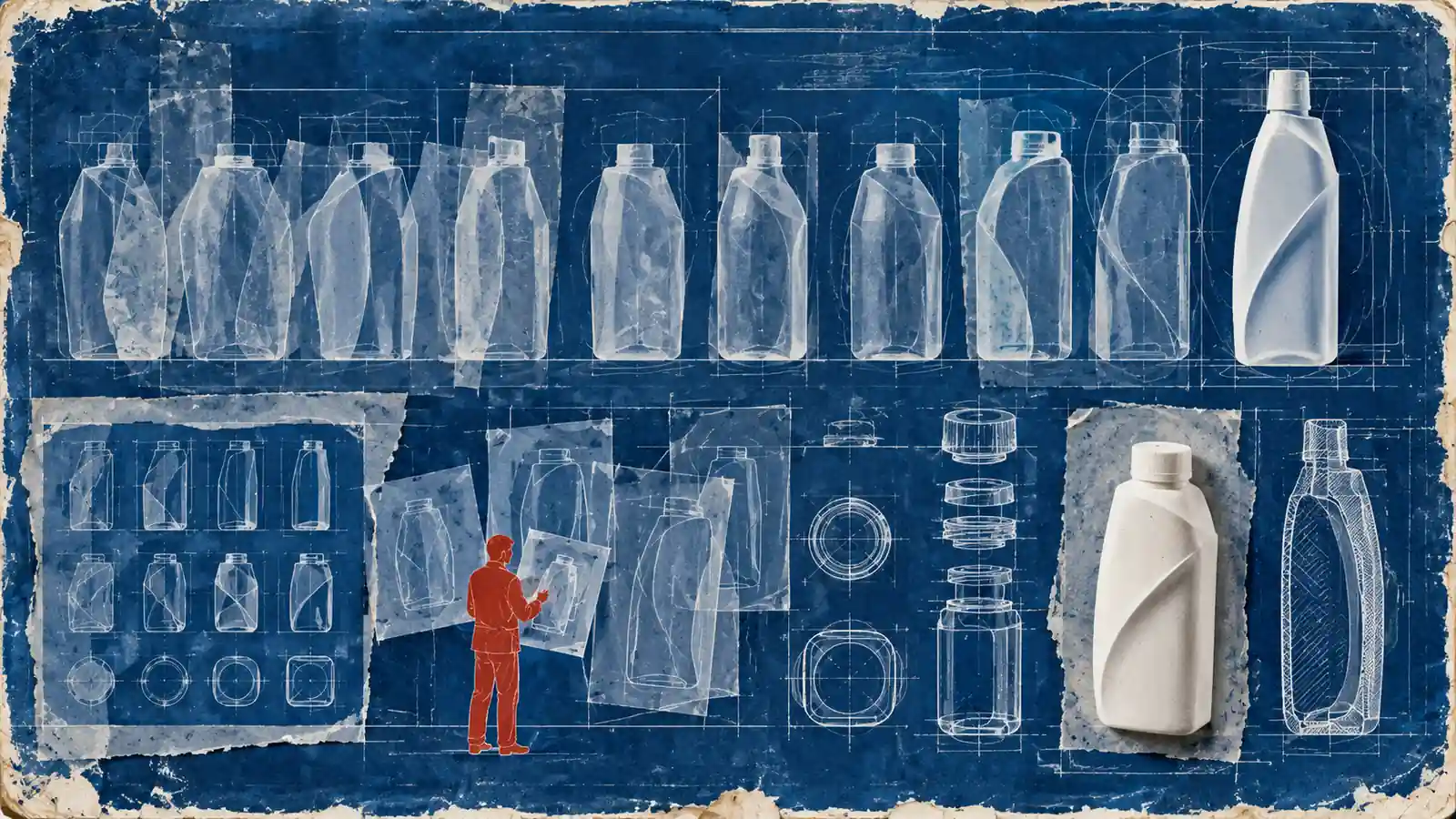

A product design can feel new to the team that created it.
That does not necessarily make it legally or strategically novel.
Indonesia's Industrial Design Law provides protection for designs that are new. Under Article 2, a design is considered new when, at the filing date, it is not the same as previous disclosures made in Indonesia or elsewhere.
In January 2026, Indonesia's Directorate General of Intellectual Property again reminded applicants that novelty is central to industrial-design registration.
For businesses, this should matter long before an application form is filed.
The Problem Becomes Expensive After Tooling
Imagine a company developing a new bottle.
The industrial designer has been paid.
Engineering dimensions are frozen.
The mould is manufactured.
Suppliers are booked.
Secondary packaging is ready.
Photography is complete.
The launch campaign is scheduled.
Only then does the company discover a highly similar design that had already been publicly disclosed.
The problem is no longer the application fee.
The business may already have sunk costs in design, engineering, tooling, production setup, inventory, marketing and lost time.
Novelty searching can therefore be understood as investment discipline.
The more expensive a design becomes after freeze, the more valuable early searching becomes.
Search Before Design Freeze
DJKI's practical novelty guidance recommends searching DJKI and WIPO databases, image-search engines and e-commerce platforms for similar existing designs. It also recommends considering the overall visual impression, rather than relying only on minor details, and avoiding premature public disclosure.
This changes the design question.
The purpose is not simply to find an identical object.
Product teams can map the category.
What forms dominate?
Which proportions repeat?
How are major elements configured?
Which visual characteristics make competitors distinctive?
How crowded is the design territory?
The question then becomes:
“Where is our design genuinely different from what already exists?”
A Database Is a Starting Point, Not the Whole World
WIPO's Global Design Database provides free access to more than 15 million designs, combining Hague registrations with participating national and regional collections.
WIPO nevertheless recommends considering national and regional registers and additional sources as well.
Prior disclosure does not necessarily sit neatly in one design database.
A product may have appeared in a catalogue, website, marketplace, advertisement or other public source.
DJKI's novelty guidance even notes that a design previously uploaded publicly does not simply regain novelty because the social-media post is later deleted.
Novelty therefore has a time dimension.
When a design becomes public can matter almost as much as how it looks.
Do Not Assume Every Grace Period Works the Same Way
Indonesia's Industrial Design Law contains certain six-month disclosure exceptions, including particular official exhibitions and experimental use for education, research or development.
Businesses should not translate this into:
“We can always launch first and register later.”
WIPO warns that grace-period rules vary between jurisdictions and generally recommends careful filing before disclosure where protection may be important.
For products intended for several markets, the launch calendar and IP calendar should therefore be considered together.
AI Makes Searching Easier, Not Novelty Automatic
On 1 October 2026, WIPO introduced an AI-powered advanced search feature in the International Designs Bulletin.
Users can describe what they want in natural language, and the system converts that request into a structured advanced-search query without requiring users to manually build field codes and operators.
That is an important usability improvement.
It should not be mistaken for automated novelty examination.
The AI feature helps create the search query.
It does not certify that a design is novel.
WIPO itself explains that the International Bureau does not examine Hague applications for novelty. Designated Contracting Parties may refuse protection under their own requirements, including on novelty grounds.
AI can improve the interface.
It does not eliminate professional judgement.
Searching Is Risk Reduction, Not a Legal Guarantee
Design searching can still produce significant business value.
A product team can discover prior designs early.
Designers can understand crowded visual territories.
Management can decide whether stronger differentiation is required before tooling.
But no search gives an absolute guarantee that the design will obtain registration, avoid every third-party right or be considered novel in every jurisdiction.
Databases have coverage limitations.
Terminology can vary.
Product classifications may differ.
Public disclosures can appear outside formal registers.
The relevant legal test also depends on jurisdiction and circumstances.
Searching should therefore be seen as risk reduction, not certainty.
Search Can Improve Creativity
Some designers worry that reviewing existing products will constrain creativity.
A better approach is to use search to identify where the category has already converged.
Which shapes exist because of function?
Which are simply habits?
Where is the category visually crowded?
Which areas remain open for meaningful exploration?
This allows product teams to make differentiation more deliberate.
Search becomes an input to creativity rather than merely a compliance exercise.
From Design Intent to Tooling
As a GATICORP editorial framework:
Design Intent → Landscape Search → Similarity Review → Differentiation → Prototype → Protection Decision → Tooling / Launch
Early stages are comparatively inexpensive to change.
Later stages are not.
Before moulds are cut, a radius can still be adjusted easily.
After tooling, the same change has a financial consequence.
Before production, proportion is a design decision.
After inventory exists, it becomes a balance-sheet decision.
That is why industrial-design thinking should not begin only when the product is ready to register.
It can start much earlier.
Before design freeze.
Before tooling.
Before production commitment.
Before the launch makes the form public.
A product needs to look distinctive to customers.
But before making a major investment, the company should ask another question:
Does this design genuinely have room to be considered new?
- Indonesia Law No. 31 of 2000 on Industrial Designs. Used for the novelty requirement and defined exceptions concerning prior disclosure.
- DJKI, 16 January 2026 — Industrial Design Registration Guidance. Used for Indonesia's current public guidance on design novelty and protection.
- DJKI — Industrial Design Novelty Guide. Used for suggested searches through DJKI, WIPO, image search and e-commerce, overall visual impression, and avoiding premature disclosure.
- WIPO — Searching Protected Designs and Global Design Database. Used for database coverage and guidance to search beyond one source.
- WIPO, 1 October 2026 — AI-Powered Advanced Search. Used for the new natural-language query-building capability in the International Designs Bulletin.
- WIPO Industrial Designs FAQ. Used for general international context on novelty, public disclosure and differing grace-period rules.
- Editorial note: a novelty search does not guarantee registration or freedom from third-party rights. Actual assessment may require wider searching and professional legal advice. The GATICORP framework is a product-development tool, not an official DJKI or WIPO examination methodology.
Published: October 21, 2026