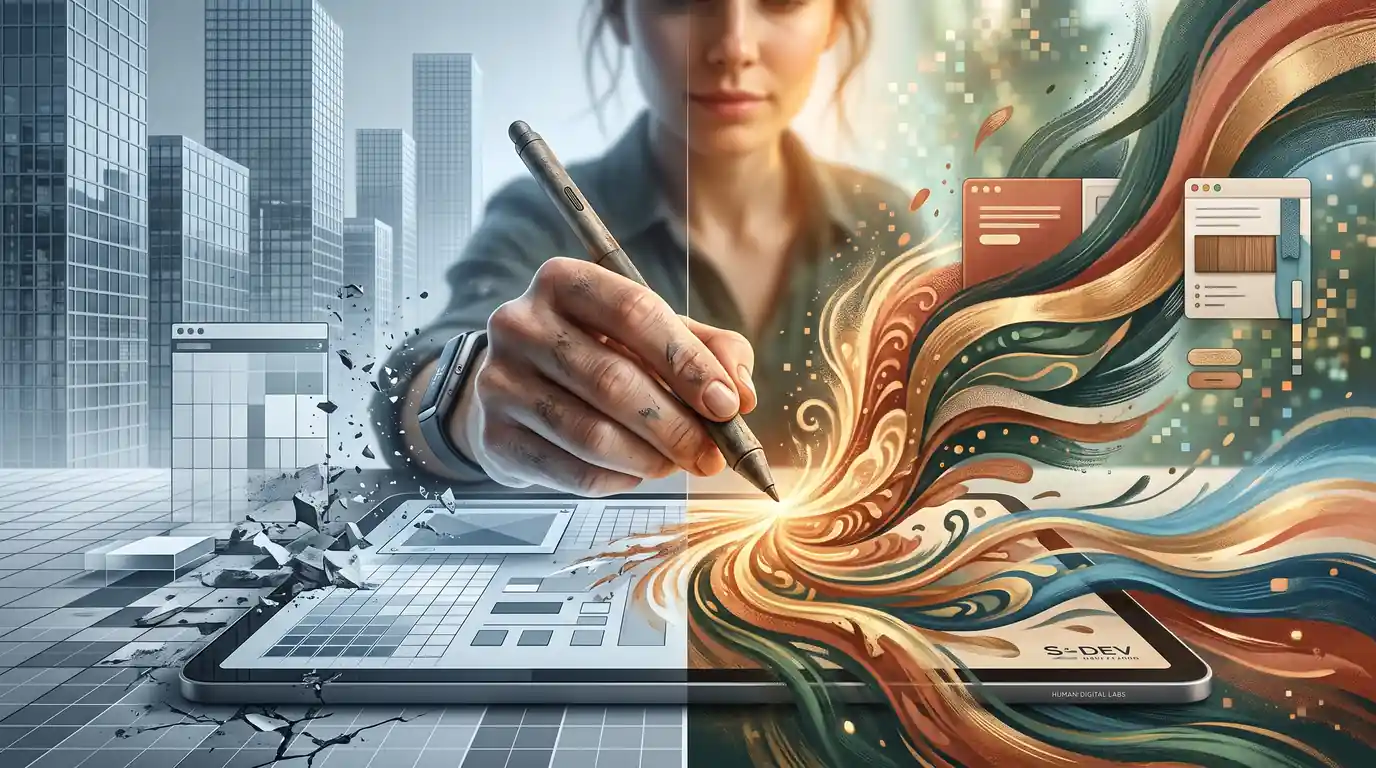

Imagine opening five different fintech apps on your phone, only to realize they look exactly the same. The same corporate white backgrounds, perfectly rounded corners, and pastel-colored flat illustrations of faceless humans. Everything is neat. Everything is efficient. Yet, it all feels remarkably soulless.
This is not a hypothetical scenario; it is the reality of our current digital landscape. As generative AI makes visual creation instantaneous, the industry has fallen into a trap of visual homogeneity. Brands are trading away their unique identity for the sake of sheer production speed.
Fortunately, the tide is turning rapidly.
When Consumers Tire of Synthetic Perfection
A recent report by Nielsen Media (2026) highlights a telling statistic: 68% of global consumers have started to ignore digital advertisements that rely on generic AI visuals due to a perceived lack of authenticity. Audiences long for a distinct character. Interfaces that look too polished and sterile now trigger skepticism rather than trust.
In emerging markets like Indonesia, this response has fueled a creative renaissance. Data from Kemenparekraf (2025) indicates that the creative economy sector, including digital design, grew by 5.7%. This growth is heavily driven by local brands embracing bold visual identities that root themselves in cultural heritage while rejecting rigid, globalized templates.
The Rise of Eccentric Expression and Raw Interaction
What does this shift look like in practice? Industry analysis published by TechCrunch (2026) reveals that 82% of leading digital designers are deliberately adopting neo-brutalism and imperfect 3D elements.
Three major shifts dominate the digital stage today:
- Maximalist Typography with Character: Fonts are no longer mere vehicles for text; they are the core visual statement. Designers deploy bold, custom typography to convey a brand's raw emotion.
- Modern Hyper-Local Elements: Integrating contemporary patterns inspired by traditional textiles or regional architecture into sleek, functional digital ecosystems.
- Unpredictable Micro-Interactions: Subtle, organic animations triggered by user actions that provide psychological satisfaction, making the interface feel alive.
This movement goes beyond aesthetics. It is a strategic imperative to command attention in a crowded digital space.
Practical Implications for Modern Businesses
Business leaders can no longer relegate design to an afterthought at the end of a product cycle. Digital design serves as the primary bridge connecting your core business values to consumer emotions.
To remain relevant, evaluate your current digital assets. Does your website or mobile application reflect a unique personality, or does it resemble a template that anyone could replicate in seconds? Investing in visual originality is no longer a luxury—it is a baseline requirement to stand out from the competition.
FAQ (Frequently Asked Questions)
- Does the 2026 digital design trend mean minimalism is dead? Not at all. Minimalism still serves an essential role in user navigation and clarity. However, that functional structure is now paired with bolder, high-character visual elements rather than sterile, empty spaces.
- How can companies balance AI tools with the need for authentic design? Utilize AI primarily for rapid ideation, conceptual research, or mood boarding. The final visual refinement, execution of intricate details, and brand alignment must remain guided by human intuition and emotional intelligence.
- Why are localized elements crucial in global digital design? Localized elements foster a deep sense of familiarity and trust among domestic audiences while presenting a refreshing, unique perspective when your brand competes internationally.
- TechCrunch Report (2026): The State of Digital Design 2026: Human-Centricity Over Automation (https://techcrunch.com/design-trends-2026)
- Nielsen Media Research (2026): Consumer Response to AI Visuals and Authenticity (https://nielsen.com/insights/ai-visuals-2026)
- BPS & Kemenparekraf RI (2025): Creative Economy Growth Report Indonesia (https://kemenparekraf.go.id/statistik-2025)
Published: June 26, 2026