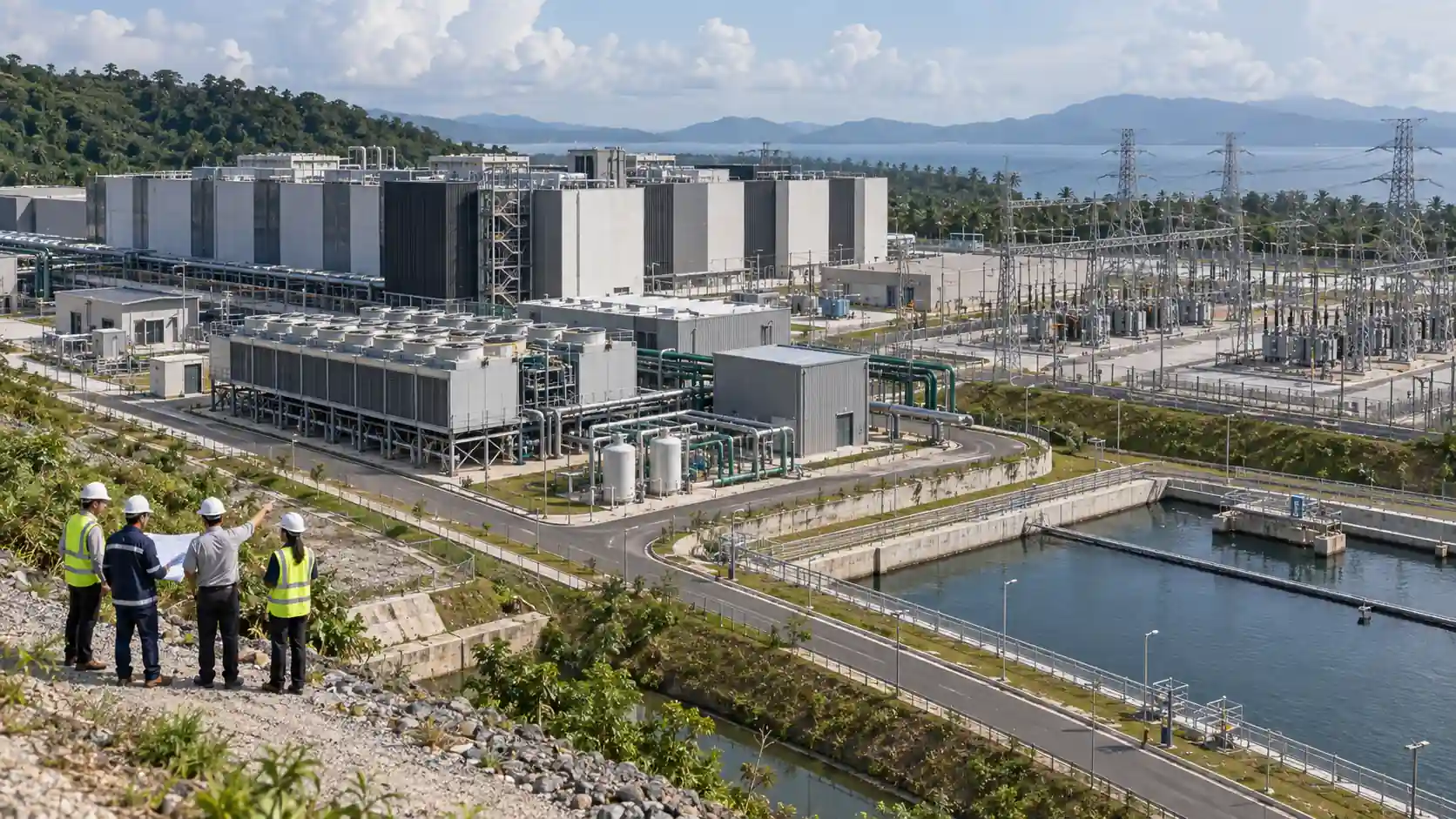

On 22 September 2026, BDx announced the groundbreaking of its CGK4 AI data centre campus in Jatiluhur, West Java. The company describes plans for up to 640 MW of IT capacity, supported by 845 MVA of PLN grid capacity, with development expected to proceed in phases over roughly three years. Eight days later, the West Java provincial government ordered construction to pause because the project's environmental impact assessment and building approval had not yet been issued. Authorities also called for greater public visibility into assessments covering noise and water use from the Jatiluhur reservoir. BDx Data Centers
The significance extends beyond one project's permitting process. It highlights an aspect of artificial intelligence that often disappears behind discussions about models and chips: AI is a digital business built on highly physical infrastructure.
The cloud is not really in the cloud. Models run on servers. Servers sit inside buildings. Those buildings require electricity, grid connections, cooling, telecommunications, land, construction, backup systems, permits and a workable relationship with the environment around them.
Compute Is Increasingly an Energy Question
The International Energy Agency estimates that data centres consumed around 415 TWh of electricity globally in 2024, approximately 1.5% of worldwide electricity demand. In its base case, consumption reaches roughly 945 TWh by 2030. AI is an important driver as accelerated computing increases power density inside data centres. IEA
Those figures cover data centres overall, not AI alone. Yet they illustrate an important shift for corporate decision-makers: access to GPUs does not automatically mean access to computing capacity.
Large-scale facilities must also secure electricity, grid connections, internal distribution systems, redundancy and enough cooling to continuously remove the heat generated by dense computing equipment.
The IEA highlights another mismatch. Technology infrastructure can move on a relatively short development cycle, while power networks and other energy infrastructure often require much longer planning and construction lead times. IEA
Behind time-to-compute, therefore, sits another increasingly important metric: time-to-power.
Power Is Not the Only Constraint
The ASEAN Guide for Sustainable Data Centre Development frames the challenge as a Digital Infrastructure Trilemma: the region must balance digital expansion, environmental sustainability, and resilience and resource security. Its framework treats energy, emissions, water, cooling, waste and cross-sector planning as core elements of data-centre development. ASEAN Main Portal
Water is particularly relevant because cooling systems must operate continuously, while Southeast Asia's tropical climate can increase cooling requirements. Actual water demand, however, varies substantially depending on facility design and cooling technology.
For that reason, this article does not estimate CGK4's water consumption: sufficiently robust project-specific data is not publicly available.
The key point is that a data centre cannot be evaluated only by asking how many megawatts it has.
Other questions matter just as much. Where will the electricity come from? Can the grid support the load? How will heat be removed? How are water resources managed? How resilient is the facility to disruptions? And can environmental approvals, construction and utility delivery keep pace with demand for computing capacity?
The Jatiluhur Lesson: Execution Risk Becomes Technology Risk
BDx describes CGK4 as having up to 640 MW of IT capacity and 845 MVA of PLN utility supply. These figures measure different things: IT load refers to the capacity available for technology equipment, while MVA describes electrical supply capacity on the utility side. BDx Data Centers
That distinction is useful because discussions about AI infrastructure frequently compress multiple engineering layers into one headline capacity figure.
The Jatiluhur case also illustrates why environmental and building approvals are not merely administrative work to be completed after the technical design. When infrastructure requires significant energy, cooling, land and supporting utilities, environmental assessment, community engagement, utility coordination and construction planning become part of the execution architecture itself. PPID Jabar
In that sense, regulatory risk and infrastructure risk can become compute risk.
What Should Companies and Investors Ask?
For businesses assessing colocation providers, developing private AI capacity or considering digital-infrastructure investment, server specifications are only one part of due diligence.
Strategic assessment increasingly needs to include grid availability and redundancy, energisation schedules, cooling architecture, water strategy, PUE and WUE, environmental and construction approvals, disruption resilience and the ability to commission capacity in stages.
ASEAN's own guidance encourages measures such as Power Usage Effectiveness (PUE) and Water Usage Effectiveness (WUE) alongside more integrated planning across energy, water, ICT and land use. ASEAN Main Portal
As AI becomes embedded in core business operations, separating technology strategy from infrastructure strategy becomes increasingly difficult.
The next phase of AI competition will therefore not be determined only by who has the strongest models or the largest number of GPUs. Part of the advantage will belong to organisations able to secure power, build facilities, manage resources, navigate approvals and operate those systems reliably.
Servers may run AI. Infrastructure is what keeps the servers running.
- Primary sources include the West Java Provincial Government, BDx Data Centers, the International Energy Agency's Energy and AI analysis, and the ASEAN Guide for Sustainable Data Centre Development.
- The 415 TWh and 945 TWh figures describe global data-centre electricity consumption, not AI-only consumption. The article does not estimate CGK4 water demand. It also avoids relying on conflicting public figures regarding the project's land area and instead uses BDx's stated 640 MW IT capacity and 845 MVA utility supply as distinct technical metrics.
Published: October 6, 2026