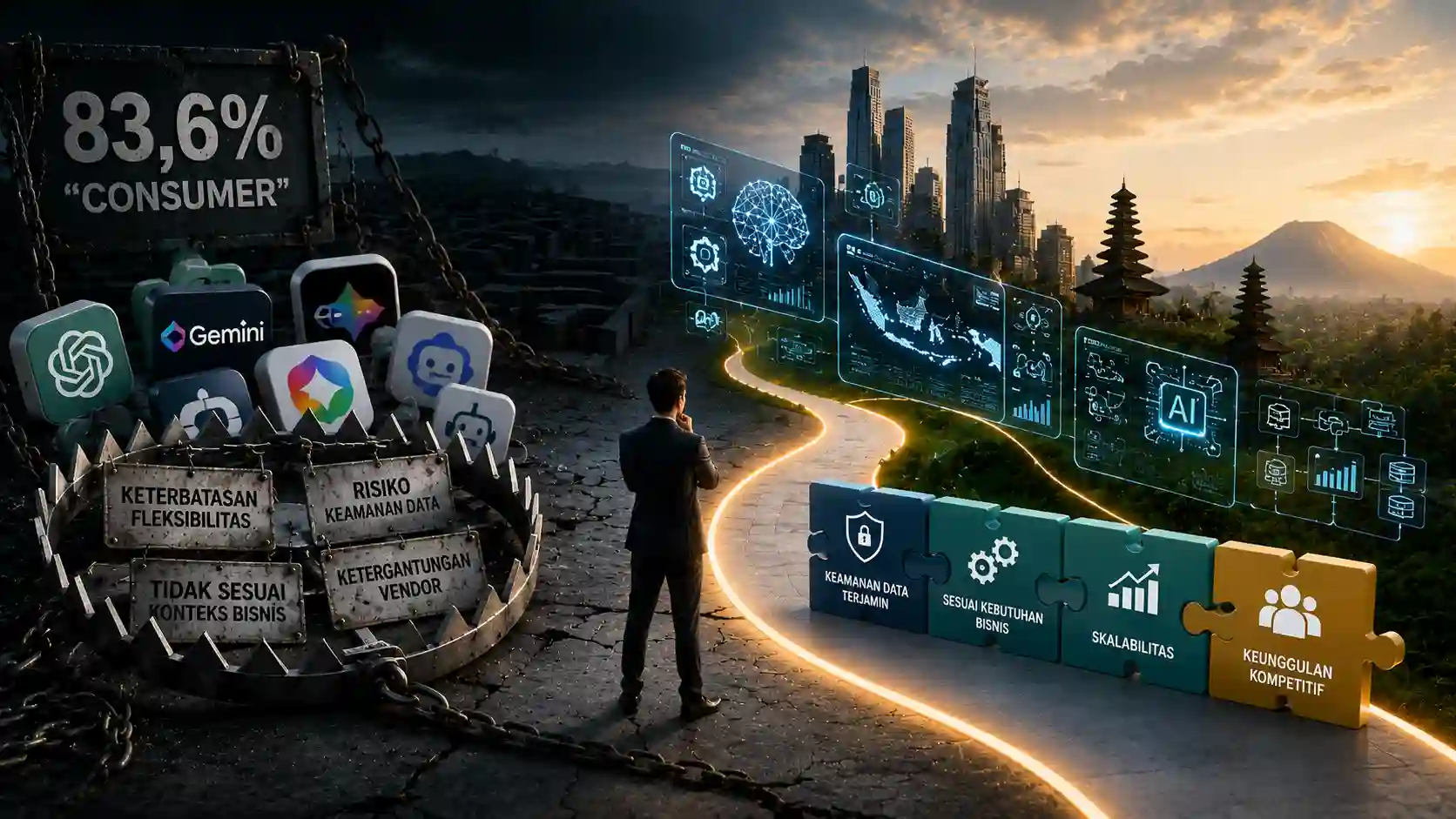

Indonesia is experiencing an incredibly fast explosion in technological adoption. During a general hearing with Commission I of the Indonesian House of Representatives (DPR RI) in late May 2026, the Indonesia Artificial Intelligence Research and Innovation Collaboration (Korika) revealed a stunning data point: 83.6% of the Indonesian population now actively utilizes artificial intelligence tools in their daily routines. This metric highlights a mature digital market ready for scale.
However, a serious warning sign is embedded directly within this statistic. Korika's Secretary-General pointed out that over 90% of this 83.6% consumer base operate strictly as takers—passive users relying entirely on external, foreign-hosted platforms like ChatGPT. Meanwhile, basic structural understanding regarding data ethics and national data security sits at a low 61%. This dynamic creates a dangerous technological dependency for domestic commercial institutions.
Deploying mass, consumer-grade public AI tools to process proprietary corporate data is a massive operational risk. When an enterprise uploads internal source codes, commercial client records, or private cashflow statements into third-party public web models, it leaves itself completely open to data harvesting. The logical path forward for enterprises demanding growth without compromising data security is the architecture of proprietary, custom internal AI models operating on dedicated secure corporate nodes.
Corporate AI Architecture Comparison:
- Public AI Tools (Consumer): Low entry cost, severe corporate data exposure, zero specific optimization for localized operational flows.
- Custom AI Systems (Builder): Absolute data sovereignty, models explicitly trained on internal corporate intelligence, sustainable competitive edge.
Transitioning from a basic tool user to an autonomous system developer is the primary strategic decision that defines market leaders in this era of digital transformation.
Frequently Asked Questions (FAQ):
- Why are public consumer AI tools dangerous for businesses? Because confidential data fed into public prompts can be processed and utilized by global infrastructure firms for public model training, violating internal privacy.
- What are the main advantages of developing a proprietary AI setup? Full architecture sovereignty, ironclad commercial data compliance, and flawless integration with your local transactional operations or proprietary ERP platforms.
- What is the Indonesian government's legislative stance on AI? The Ministry of Communication and Digital (Komdigi) alongside parliament is actively constructing local data privacy framework codes to enforce sovereign technology standards.
In conclusion, do not let your corporation remain a passive metric in global consumer reports. Command your operational future by engineering customized, highly adaptive technology architectures.
- Kompas.com — Expert Panels at DPR: 83.6 Percent of the Public Already Using AI — Kompas URL — Accessed May 30, 2026
Published: May 30, 2026