
For several years, the AI conversation has largely revolved around models: which one is smarter, faster or better at performing human tasks.
Behind every model, however, sits something much more physical.
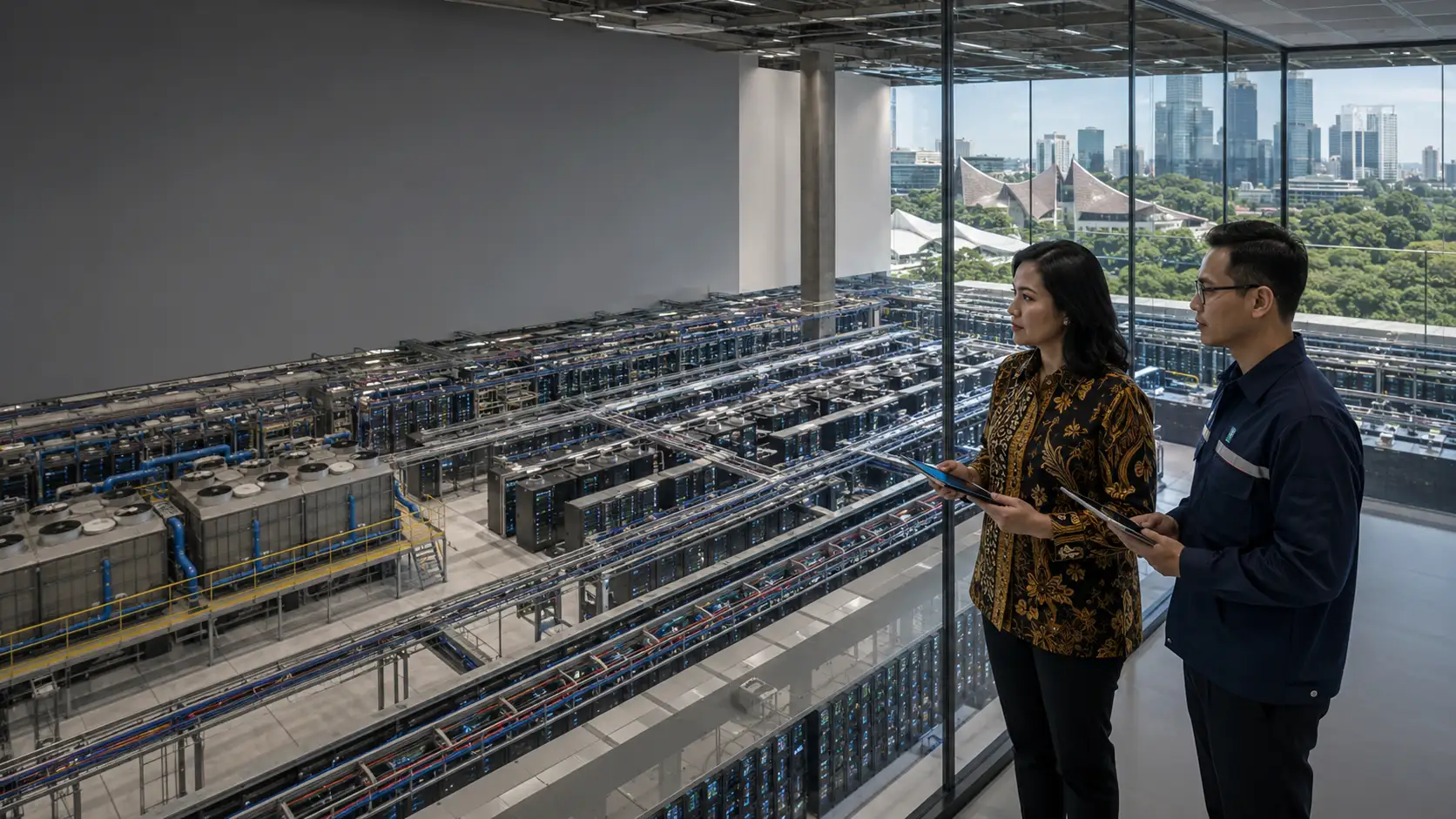
Buildings, electricity, servers, GPUs, networks, cooling systems and people.
CoreWeave's planned expansion into Indonesia makes that layer easier to see.
The US-based AI cloud company has announced its first Asia-Pacific data-center presence through three facilities in Indonesia totalling 360 MW of contracted IT power, expected to come online in 2028.[1][2]
Indonesia's AI story is therefore beginning to move beyond applications and toward infrastructure.
360 MW does not mean the capacity is operating today
The 360 MW figure sounds substantial, but precision matters.
CoreWeave describes it as contracted IT power across three planned facilities. Those facilities are not yet operating and are expected to come online in 2028.[1]
The number should therefore not be described as 360 MW of currently active Indonesian AI capacity. Nor is contracted power the same thing as actual future electricity consumption.
What can be said today is that CoreWeave has made a significant infrastructure commitment for its first Asia-Pacific expansion.
The company also plans to build and train a local team to operate the facilities.[1]
That makes the story more consequential than another data-center construction project.
AI increasingly needs compute closer to users
CoreWeave says enterprises, AI-native companies and governments across Asia increasingly require compute located closer to their data and users, partly because of latency-sensitive workloads and data-locality requirements.[1]
As AI moves from experimentation into production, infrastructure location becomes more important.
A simple chatbot may tolerate some delay.
Industrial applications, financial systems, real-time analytics, agentic workflows or systems using sensitive information can have very different requirements.
That does not mean every dataset must reside inside Indonesia. Data-location and transfer requirements depend on the type of information, sector, architecture and applicable regulation.
But for CIOs, where compute runs is increasingly connected to performance, resilience and governance.
The AI race is also becoming a power race
Indonesia's Ministry of Communication and Digital Affairs said in July that global AI competition is increasingly shaped by infrastructure including energy, data centres, chips, compute and talent.[3] It has also highlighted national compute clusters as part of the effort to move beyond being merely a technology user.[4]
That changes how companies should think about AI.
AI is not simply a software subscription.
At scale, it becomes an industrial system.
Compute requires reliable power. Hardware produces heat and needs cooling. Clusters require fast networks. Operations need cybersecurity, redundancy and specialised people.
Komdigi has described sovereign AI as a full stack extending from electricity, water and GPUs to chips, platforms and applications.[5]
The larger AI becomes, the more closely it becomes connected to physical infrastructure.
The opportunity extends beyond data centres
For Indonesian companies, the relevant question is not only who sells the cloud service.
AI infrastructure can potentially create demand across construction, electrical engineering, cooling, fibre networks, cybersecurity, facility management, power systems and technical services.
That opportunity, however, does not automatically become local revenue.
It depends on procurement structures, technical standards, supplier capability, certification and how much of the value chain can realistically be developed domestically.
The same applies to employment.
CoreWeave's plan to build a local team becomes more valuable if it develops deeper technical capability rather than only basic operational roles.
Komdigi has similarly argued that global AI investment should bring technology transfer and stronger domestic skills.[6]
More data centres do not automatically create an AI hub
This is where optimism needs discipline.
Local compute can be strategically useful, but an AI ecosystem is not built on megawatts alone.
Indonesia also needs developers, cloud engineers, cybersecurity specialists, research capability, companies deploying AI productively and institutions capable of managing technology risk.
Infrastructure without productive demand can become capacity.
Demand without talent produces shallow adoption.
Talent without access to compute struggles to innovate.
All three need to develop together.
What business leaders should ask
For executives, CoreWeave's expansion is better treated as a signal than as an immediate reason to migrate every workload.
Useful questions include:
Does our AI workload require low latency?
How sensitive is the data?
Should the architecture be single-cloud or multi-cloud?
What happens to compute cost as AI usage scales?
How resilient is the business if one region becomes unavailable?
And do we have people who understand the infrastructure layer?
Those questions become more important as AI moves from experimentation into core corporate systems.
AI ultimately returns to the physical world
There is an interesting paradox in AI development.
The technology appears increasingly virtual while its requirements become increasingly physical.
More advanced systems demand chips, electricity, connectivity, cooling and engineering.
CoreWeave's Indonesia plan makes that shift unusually visible.
Three facilities and 360 MW of contracted IT power do not prove that Indonesia has already become an Asian AI hub.
They do show that the location of compute is becoming strategically valuable.
Indonesia's larger opportunity is therefore not merely to host servers.
It is to ensure that infrastructure investment also strengthens talent, suppliers, technical capability and productive AI demand that can outlast the buildings themselves.
- [1] CoreWeave / Business Wire. CoreWeave Expands Cloud AI Platform to Indonesia, Marking First Move Into Asia-Pacific Region. 4 August 2026.
- [2] Reuters. CoreWeave expands into Indonesia, announces first data center in Asia-Pacific. 4 August 2026.
- [3] Kementerian Komunikasi dan Digital. Persaingan AI Kini Ditentukan Infrastruktur, Bukan Sekadar Aplikasi. 15 July 2026.
- [4] Kementerian Komunikasi dan Digital. Compute Cluster Jadi Kunci Daya Saing AI Indonesia. 6 July 2026.
- [5] Kementerian Komunikasi dan Digital. Bangun Kemandirian Teknologi dari Model hingga Infrastruktur, Indonesia Siapkan Sovereign AI. 23 July 2026.
- [6] Kementerian Komunikasi dan Digital. Investasi AI Harus Hadirkan Transfer Teknologi bagi Indonesia. 10 June 2026.
- 360 MW adalah contracted IT power, bukan kapasitas aktif saat ini atau konsumsi listrik aktual.
- Fasilitas ditargetkan online 2028, bukan 2026.
- Artikel tidak menyatakan CoreWeave sebagai operator data center yang sudah aktif di Indonesia.
- Data locality tidak disamakan dengan kewajiban universal menyimpan seluruh data di Indonesia.
- Potensi supplier dan pekerjaan lokal ditulis sebagai opportunity, bukan outcome yang sudah dijamin.
- Artikel tidak menyimpulkan investasi ini otomatis menjadikan Indonesia AI hub.
Published: August 17, 2026