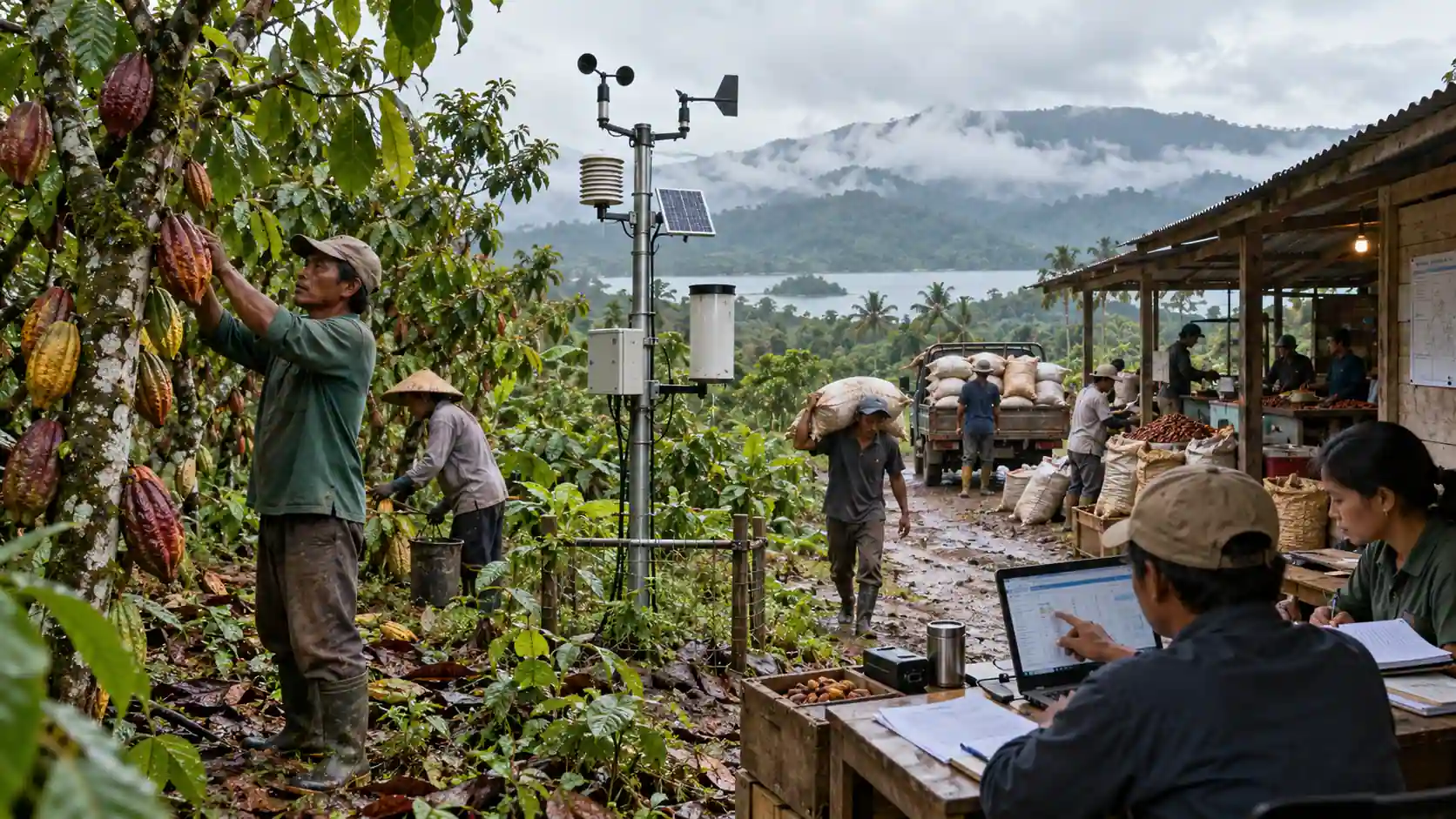

In its September 2026 Board of Commissioners report, Indonesia's Financial Services Authority described expanded use of financial services in the cocoa ecosystem in Southeast Sulawesi. Businesses are being connected with financing and risk protection that includes life insurance, employment-related insurance and parametric weather insurance.
The last term remains unfamiliar to many business owners.
In indemnity-based insurance, payment generally relates to the loss suffered and is assessed according to the policy terms.
Parametric insurance uses a different architecture.
The central question is not always “How much damage actually occurred?”
It may instead be:
“Did the agreed parameter reach the trigger?”
The distinction sounds small. Its implications are significant.
The Trigger Is What Gets Measured
An OJK publication has explained parametric insurance using earthquake magnitude and rainfall as examples. Payment can be determined when a predefined physical parameter reaches the contracted threshold rather than solely through an individual post-event assessment of the damage.
The World Bank uses similar principles when describing index-based insurance. Depending on the product, parameters may include rainfall, river levels, wind speed, vegetation conditions or other independently measurable indicators. Once the contracted trigger is reached, the payout follows a predefined structure or formula.
Consider a conceptual drought cover using accumulated rainfall during a defined period.
If data from the agreed source falls below the contractual threshold, the policy may trigger a payout.
The insurer does not necessarily need to visit every individual farm and calculate each producer's crop loss through the same field-by-field adjustment process used in traditional indemnity insurance.
That is one of the model's attractions.
Why Can Payouts Be Faster?
Because both the trigger and payment formula are established in advance, post-event processing can rely less on individual physical loss assessment.
The World Bank notes that parametric structures can provide faster liquidity following disasters because payouts use predefined parameters or indexes. Some programmes are deliberately designed to deliver liquidity for immediate post-disaster needs.
The important word is can.
Parametric insurance does not guarantee instantaneous payment.
Data still needs to become available. The trigger must be verified against the policy wording. The agreed data source and calculation mechanism must operate correctly. Administrative and payment processes still matter.
Speed is therefore not simply a marketing claim.
It is an outcome of product architecture and operational execution.
The Central Trade-Off: Basis Risk
Removing individual loss assessment creates another challenge.
The parameter is a proxy for loss. It is not the loss itself.
The World Bank describes the mismatch between index-based payments and actual losses as basis risk. An insured party can suffer serious damage while the index fails to move far enough to trigger a payment. The reverse can also occur: the trigger produces a payout even though the individual's actual loss is smaller.
Imagine two farms only a few kilometres apart.
A weather station records rainfall above the policy's drought threshold. One farm, however, experiences much more serious stress because of soil conditions, topography, crop variety or a local microclimate.
If the policy follows the station data, the farmer's loss experience and the index may diverge.
That gap is basis risk.
Data Is Part of Product Quality
Because payment can depend directly on a parameter, data quality becomes part of insurance-product quality.
World Bank work on parametric risk modelling emphasises that an index needs a sufficiently strong relationship with the economic loss it is intended to represent. Models need appropriate data and methodology, calibration, validation and updating where necessary.
This raises highly practical questions.
Where does the data come from?
A weather station, satellite observations, or both?
How close is the measurement point to the exposure?
What time period is measured?
What happens if data is missing?
Which source has contractual authority?
How does the payout formula behave after the first threshold is crossed?
These are not merely technology or actuarial questions.
They influence whether the product responds sensibly to the customer's risk.
A Simple Trigger Does Not Necessarily Mean a Simple Product
From a customer's perspective, “if rainfall falls below X, the policy pays Y” sounds straightforward.
Real-world experience shows that trust can still become difficult when customers experience extreme conditions but the contracted index does not trigger.
CGAP's 2026 review of climate-linked inclusive finance again identifies trigger setting and basis risk, together with product complexity and trust, as recurring issues. Customers can struggle to understand why the conditions they personally experience do not produce a payment when the policy's measurement source shows something different.
Disclosure therefore needs to explain more than benefits.
Customers need to understand the trigger, the data source, situations that will not trigger payment, the payout calculation, and the possibility that actual loss and payout will diverge.
For parametric products, understanding the trigger can be almost as important as understanding coverage.
Not Every Risk Is Suitable for a Parametric Structure
Parametric insurance works best when an objective measure has a sufficiently useful relationship with the economic risk being protected.
World Bank agricultural-insurance research notes that index approaches are generally better suited to hazards with stronger spatial correlation, while highly localised hazards can create much greater basis risk.
Parametric insurance should therefore not be treated as a universal replacement for indemnity insurance.
In some situations, parametric protection can provide rapid liquidity or protect a particular layer of risk. Indemnity cover may still be preferable when actual asset damage and individual loss conditions are central to the protection required.
The two structures solve different design problems.
Read the Product from Risk to Payout
As an educational framework, GATICORP uses:
Risk → Parameter → Data Source → Trigger → Payout Formula → Basis Risk
Risk — what economic loss is being protected?
Parameter — what measurable variable can represent it?
Data Source — who or what measures that variable?
Trigger — what condition activates payment?
Payout Formula — how is the payment calculated?
Basis Risk — how likely is the payment to diverge from actual loss?
This is not an OJK regulatory methodology and does not replace policy wording or actuarial analysis.
It highlights something important: parametric insurance is not merely “faster claims”.
It shifts part of the complexity from loss adjustment after the event into data and product design before the event.
When Data Becomes Part of the Insurance Promise
Traditional insurance buyers commonly examine sum insured, coverage, deductibles, exclusions and claims processes.
Parametric insurance introduces another important layer:
measurement architecture.
The more heavily payout depends on a parameter, the more important it becomes to understand how that parameter is created.
This is the central lesson of parametric insurance.
Objective triggers can simplify and accelerate post-event payment.
But simplicity after the event depends on careful design before the event.
In a parametric policy, data is not merely supporting evidence. It forms part of the mechanism that determines whether the insurance promise becomes a payment.
- OJK — September 2026 Board of Commissioners Meeting. OJK identifies parametric weather insurance as part of risk-protection facilitation in the Southeast Sulawesi cocoa ecosystem. OJK September 2026 Board Meeting Release
- OJK — Unlocking Potential: Development and Strengthening of the PPDP Industry. Used for the conceptual explanation of parametric insurance and examples involving earthquake magnitude and rainfall.
- World Bank — Financial Protection Against Climate Risks. Used for the distinction between payments based on triggering events and indemnification of actual loss, and the importance of rigorous design to minimise basis risk.
- World Bank — Index Insurance and Basis Risk Research. Used for the definition of basis risk and the potential mismatch between index payouts and actual loss.
- World Bank — Parametric Insurance and Risk Modelling. Used for the importance of parameter-loss correlation, data sources, model calibration and validation.
- CGAP — Built to Adapt, 2026. Used for trigger-setting, basis-risk, product-complexity and customer-trust considerations.
- Editorial note: The rainfall-threshold example is conceptual and does not represent a particular policy. This article does not claim that all parametric products necessarily pay faster than indemnity insurance or that parametric insurance universally replaces traditional cover. Risk → Parameter → Data Source → Trigger → Payout Formula → Basis Risk is a GATICORP editorial framework.
Published: October 16, 2026