
Digital transformation is not about buying the newest software package. It is not about expanding your IT headcount without direction. Many business owners mistakenly assume that any utility operating on a computer screen automatically qualifies as a strategic digital asset.
The reality contradicts this shallow view. A genuine digital product features an architectural depth that vastly differs from a basic electronic document. According to official data from the Coordinating Ministry for Economic Affairs of the Republic of Indonesia (2026), the domestic digital economy value has approached USD 100 billion. This monumental milestone is driven by the widespread integration of intelligent systems that empower enterprises to run autonomously.
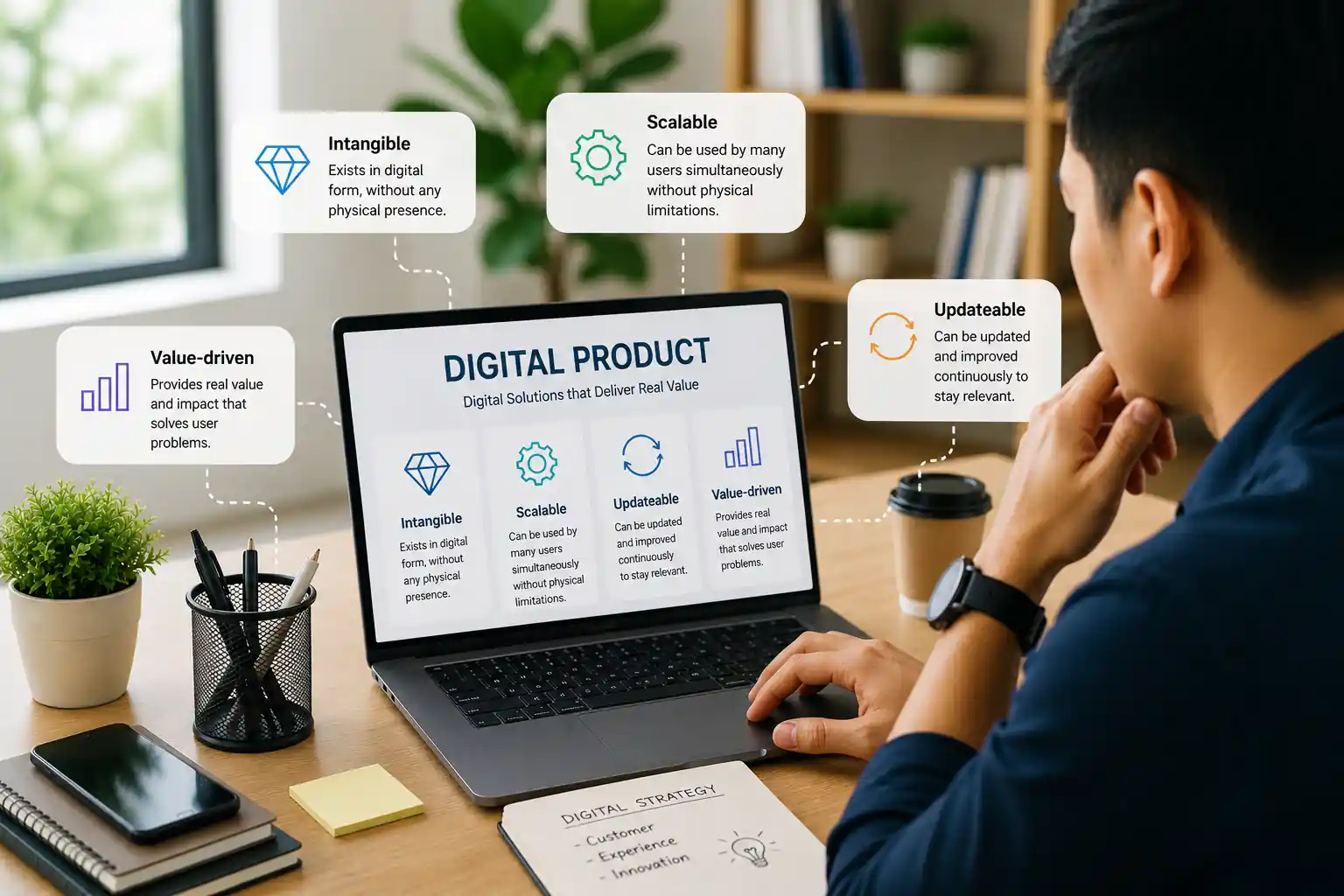
To comprehend how these assets secure long-term corporate profitability, let us analyze the four definitive characteristics of what is a digital product in today's industrial landscape.
1. Continuous Solution Delivery
Bespoke digital products are never engineered for single use or to merely follow fleeting tech gimmicks. Their core mission is to serve as unified solution spaces that continuously eliminate operational friction. For instance, a customized inventory tracking platform built for a retail supply chain monitors warehouse allocations in real-time, indefinitely.
This continuous value separates them from cheap digital commodities. These systems naturally expand alongside your organizational scale. Data published by the Central Bureau of Statistics (2026) reveals that electronic commerce transactions in Indonesia grew 6.2% quarter-on-quarter in the early months of this year. This upward trajectory confirms that adaptive digital platforms are mandatory to process escalating transactional volumes securely.
2. Absolute Agility Through Custom Software
The primary constraint of off-the-shelf commercial software is its static framework, which cannot adapt to the unique nuances of an enterprise's internal workflows. High-performing digital assets bypass this issue entirely by offering infinite scalability via flexible code modifications.
When an organization undergoes a strategic market pivot, the custom architecture can be updated within hours. You no longer have to wait for third-party vendor development roadmaps that routinely take several months to implement. This total creative freedom separates industry leaders from legacy players trapped in generic software architectures.
3. High Scalability with Zero Marginal Replication Costs
The fundamental financial advantage of non-physical assets lies in their exceptional production efficiency. Once the baseline framework is engineered, the ecosystem can onboard thousands of new active users without incurring additional physical manufacturing expenses.
This economic dynamic acts as the primary driver for optimizing long-term corporate capital expenditures (CapEx). Organizations can launch new operational branches without worrying about escalating per-user seat licensing fees that drain annual budgets. The technological infrastructure operates entirely as the company's proprietary intellectual property.
4. Data Sovereignty and Infrastructure Security
In the era of artificial intelligence, operational data leaks or customer privacy breaches represent existential threats that can destroy a brand's authority overnight. Earnest digital engineering prioritizes strict information security governance as its primary foundation.
Every backend database, automated algorithm, and transaction record remains securely encrypted within the enterprise's private cloud infrastructure. This absolute ownership ensures your business maintains total compliance with strict data privacy laws in Indonesia. Your management team commands absolute authority over the organization's most valuable information assets.
Conclusion — The Critical Takeaway
Developing a clear understanding of what is a digital product proves that investing in proprietary technology infrastructure is a strategic move, not an operational expense. Enterprises that rely indefinitely on rigid, rented third-party software will always lack the speed required to capture new market options. Dominating the modern market demands infrastructure sovereignty.
At GATICORP, we infuse our philosophy of earnest precision and conscious integrity into every line of code we engineer. Through our Digital Product Studio business line, we empower your company to design, deploy, and scale custom enterprise software, advanced data tools, and robust independent mobile apps. Elevate your corporate digital sovereignty today by reaching out to our technical specialists at business@gaticorp.com.
FAQ
- What is the core difference between a custom digital product and off-the-shelf software? Off-the-shelf software provides rigid functionalities engineered for generic mass consumption. A custom digital product is built from the ground up to match your exact business workflows, maximizing operational yield.
- How do I know when my organization needs to build an independent digital product? When recurring vendor licensing costs begin to damage your cash flow, or when your daily operations find bottlenecks due to the missing features of rented software.
- Is an independent custom system safe from third-party data vulnerability risks? Yes. Because the entire network architecture, data pipeline, and database are hosted exclusively for your enterprise, completely isolated from outside organizations.
Sources:
- Coordinating Ministry for Economic Affairs of the Republic of Indonesia. (2026). Official Press Release on National Digital Economy Growth No. HM.02.04/103/SET.M.EKON.3/04/2026.
- Central Bureau of Statistics (BPS). (2026). Quarterly Electronic Commerce Transaction Performance Report Q1-2026.
- Xendit. (2025). Xendit Wrapped 2025: Shifting Patterns in Digital Consumer Behavior.
Published: June 28, 2026
Source and editorial notes are managed through GATICORP CMS.