
When a restaurant buys poultry, beef, milk or eggs, procurement usually focuses on price, size, quality, halal requirements, delivery schedules, temperature and supply reliability.
Modern food supply chains are increasingly adding another question:
How were the animals treated before they entered the food chain?
That question is no longer limited to advocacy groups. Indonesia’s Minister of Agriculture Regulation No. 32/2025 on Animal Welfare has been in force since December 4, 2025 and covers welfare implementation, certification, supervision and public participation.[1]
In September 2026, the Ministry of Agriculture was already training auditors to support implementation at business units.[2]
Animal welfare is becoming a supply-chain governance issue.
The legal foundation is not new
Indonesia had already regulated veterinary public health and animal welfare through Government Regulation No. 95/2012.[3]
The 2025 ministerial regulation provides a more operational framework around implementation, certification, supervision and governance.[1]
Food companies should therefore avoid treating welfare as a short-lived reputation trend.
It is increasingly embedded in formal livestock governance.
Welfare, animal health, biosecurity and food safety are different
These terms are often mixed together.
Animal welfare concerns the physical and mental state of animals and how they experience their environment and treatment.
Animal health focuses more directly on disease and injury.
Biosecurity seeks to reduce the introduction and spread of disease agents.
Food safety concerns hazards to human consumers.
They interact, but they are not interchangeable.
Healthy animals do not automatically mean good welfare
An animal can be free from major disease while still experiencing chronic stress, poor handling or an inappropriate environment.
The reverse also matters.
Good welfare practice does not automatically make a food product pathogen-free.
Food safety still requires hygiene, inspection, cold-chain control, sanitation and hazard management.
Companies should therefore avoid simplistic claims that “better welfare automatically means safer food”.
WOAH treats welfare as an international standard
The World Organisation for Animal Health began publishing formal animal-welfare standards in its Terrestrial Code in 2004. The standards now address transport, slaughter, disease-control killing and production systems for cattle, broilers, dairy cattle and pigs.[4]
Animal welfare sits alongside animal health and veterinary public-health standards.
This places welfare inside operational governance rather than purely ethical discussion.
Indonesia increasingly links welfare with competitiveness
At an international animal-welfare workshop in July 2026, Indonesia’s Ministry of Agriculture described welfare as an increasingly important element of modern livestock production connected with animal health, food safety, food security and international competitiveness.[5]
The relationship needs careful interpretation.
Animal welfare alone does not cause all those outcomes.
But stronger handling, infrastructure, monitoring and management can be part of a more disciplined and auditable production system.
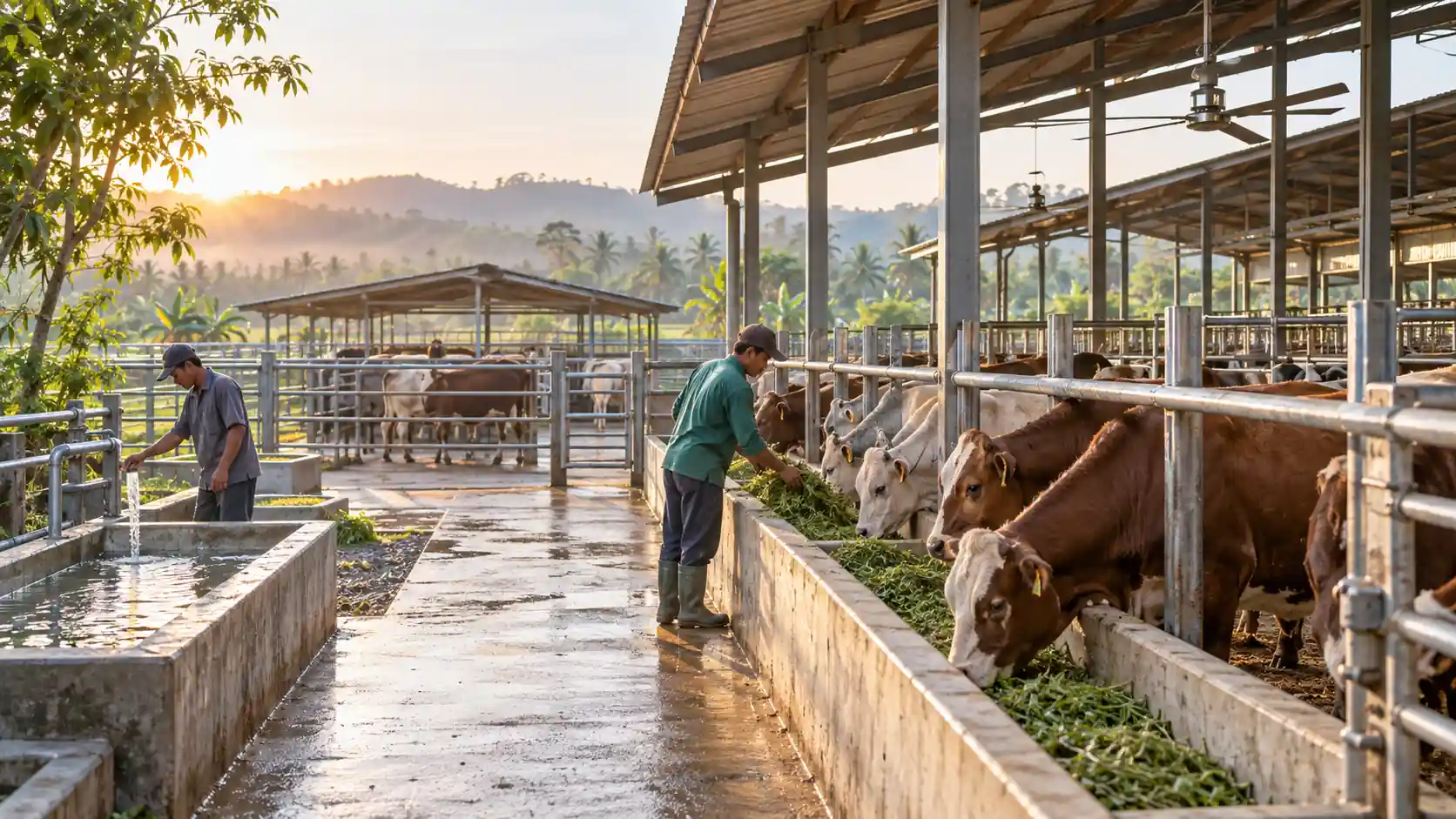
Welfare starts at the farm
Food companies often see their supply chain beginning with the distributor.
Biologically, it begins much earlier.
Housing, ventilation, water, feed, stocking conditions, health management and handling shape animals throughout production.
The quality of governance at that stage affects risks moving downstream.
Transport is a major risk point
WOAH issued a renewed statement on animal welfare during transport in January 2026, highlighting risks including inadequate preparation, health issues, long journeys and operational disruption.[6]
FAO guidance for Asia and the Pacific similarly treats transportation as a significant welfare risk and recommends reducing unnecessary movement, journey duration and poor transport conditions.[7]
Procurement should therefore not treat the journey between farm and processing facility as invisible.
Supplier standards can include handling
Food contracts are often extremely detailed about finished-product specifications.
They may be less detailed about the animal-handling practices that precede the finished product.
Companies can begin asking practical questions: How are animals loaded? Are handlers trained? How is fitness for transport assessed? What happens during extreme heat or delays? Are injury and mortality recorded?
Animal welfare becomes more manageable when it becomes auditable.
Slaughter belongs inside the chain
WOAH also maintains specific welfare standards for slaughter.[4]
This is a point where animal welfare, worker safety, hygiene, halal requirements and operational efficiency can overlap closely.
One system does not automatically satisfy another.
Food companies need these requirements to operate together rather than assuming one certification covers everything.
Halal and welfare do not need to be framed as opposites
Public discussions sometimes create a false conflict between religious requirements and animal welfare.
A more constructive operational approach is to meet halal rules while continuously improving handling, restraint, employee competence, facility design and processes that minimise unnecessary stress.
Integrated compliance is more useful than a manufactured binary.
Human competence matters enormously
Infrastructure alone does not determine welfare.
Handling does.
Staff who understand animal behaviour can move animals more safely and calmly. Poor handling can increase stress, injury and employee risk.
FAO guidance links humane handling with improvements in welfare, productivity and personnel safety.[8]
Training is therefore an operational-control issue.
Indonesia is building auditor capacity
In September 2026, the Ministry of Agriculture began training animal-welfare auditors as part of the implementation of Regulation No. 32/2025.[2]
The objective is to create people capable of applying welfare standards and conducting more objective assessments at business units.
For food businesses, the direction is clear.
Welfare claims are becoming more verifiable.
Certification can become a commercial signal
Regulation No. 32/2025 includes animal-welfare certification within its governance framework.[1]
Not every buyer will immediately demand such certification.
But suppliers serving premium retailers, hospitality companies, multinational food businesses or export chains may eventually gain advantage from demonstrating credible compliance.
As with many quality systems, the commercial value rises when buyers include it in procurement standards.
Certification does not replace daily practice
A certificate is only as good as the conditions maintained after the audit.
Water systems fail.
Ventilation changes with weather.
Peak demand can increase stocking pressure.
Transport providers can overload vehicles.
Real welfare happens every day.
That is why monitoring and management remain more important than a document alone.
Supply-chain visibility matters
Restaurant chains may buy meat through processors or distributors and never contract directly with the farm.
Consumers and regulators do not necessarily care about those contractual boundaries when a controversy occurs.
A welfare failure upstream can create reputational consequences downstream.
Traceability therefore becomes part of resilience.
Tier-one suppliers may not be enough
Procurement audits often stop at the direct supplier.
Animal-welfare risk may sit further upstream with farms, transporters or slaughter facilities.
For higher-risk categories, companies may need at least a basic map of those upstream layers.
That does not require auditing every farm continuously.
It does require understanding where critical risks live.
Welfare may support quality—but claims need caution
Poor handling can contribute to stress, injury, bruising, mortality and product losses.
In some categories, severe pre-slaughter stress can also affect product characteristics.
Those relationships matter.
But marketers should avoid converting them into sweeping claims that every higher-welfare product is automatically superior.
Animal welfare is one part of quality management.
Avoidable losses have economic value
Animals injured or lost during transport create direct economic waste.
Bruising and poor handling can also reduce usable yield.
This means some welfare improvements have a business case even when consumers are unwilling to pay a premium.
Reducing avoidable losses is operational efficiency.
Market access adds another dimension
WOAH standards support international alignment around animal health, welfare and veterinary public health.[9]
Global buyers increasingly maintain their own sourcing expectations.
Indonesia does not need to adopt every private foreign standard automatically.
But businesses targeting premium or export supply chains should understand that market access increasingly involves traceability, sanitary standards, sustainability and welfare alongside price.
Export readiness starts before the export order
Governance systems cannot be built overnight.
Records, training, SOPs, traceability and audit readiness take time.
For livestock and food businesses with export ambitions, welfare capability can be viewed as an option on future market access.
It may not generate immediate revenue.
It can increase readiness.
Restaurants need to define their own position
Not every restaurant needs to market a “higher-welfare menu”.
The first step can be far simpler.
Understand the supply chain.
Where does poultry come from?
How does the supplier handle transport and processing?
Is veterinary oversight present?
Are incidents recorded?
Does the supplier have a documented welfare policy?
The brand does not need to communicate every detail publicly.
Procurement should still understand it.
Large buyers have leverage
Retailers, processors and major restaurant groups can influence supply chains through purchasing requirements.
They can request data, audits, improvement plans and corrective action.
That leverage also brings responsibility.
If buyers demand expensive upgrades while continually squeezing supplier prices, implementation may become unrealistic.
Responsible sourcing needs economics that support compliance.
Higher standards have transition costs
Indonesia is already discussing cage-free egg production and other alternative systems in parts of the industry. A Ministry of Agriculture unit in Bali has noted that adoption becomes commercially more attractive when farmers can realise sufficient value from the market.[10]
This highlights a fundamental issue.
Standards have costs.
If buyers demand higher standards, how will investment and transition be financed?
That question cannot be solved by marketing language alone.
Consumers may support welfare without always paying more
Public attitudes and checkout behaviour are not the same.
Customers may support animal welfare in principle while remaining highly price-sensitive.
Food companies should therefore avoid building the entire commercial case around a consumer premium.
Operational efficiency, buyer requirements, market access and reputational resilience may be equally important.
Avoid welfare washing
As welfare becomes more visible, marketing claims will follow.
Terms such as “ethical”, “humane”, “responsibly raised” or “happy” can sound appealing without having precise definitions.
Brands should favour claims that can be verified.
What standard is used?
Who verifies it?
Which stage of the supply chain is covered?
Does the claim include farm, transport and slaughter, or only one part?
Transparency protects credibility.
Audits should look at outcomes too
Compliance should not stop with the existence of SOPs.
Depending on species and production system, businesses can examine outcomes such as mortality, injury, lameness, cleanliness, water access, handling behaviour and transport incidents.
No single universal metric fits every animal.
The principle is that operational policy should eventually be visible in real conditions.
Technology can help—but only if it changes decisions
Sensors, cameras, temperature monitoring, transport tracking and farm-management systems can improve visibility.
Technology alone does not improve welfare.
A heat-stress alert has no value if nobody improves ventilation or handling.
As in many digital systems, data become valuable only when operations respond.
Smallholders need a different implementation pathway
Indonesia’s livestock sector includes a broad mix of integrated companies and smaller farmers.
Standards cannot always be implemented through identical methods.
Smaller producers may require extension, cooperative structures, shared facilities, group certification or support from integrators and buyers.
Poorly designed compliance can unintentionally favour only large suppliers.
Transition needs capacity building.
Improvement can be gradual
Businesses do not need to fix every layer immediately.
Start with high-risk categories.
Map critical suppliers.
Define minimum requirements.
Build incident reporting.
Prioritise transport and handling.
Train people.
Then strengthen assurance through audits and certification.
Measured progress is more credible than broad commitments without execution.
A practical procurement framework
A food company can begin with five questions.
Source: Where do the animals come from?
Condition: How are housing, health and environment managed?
Movement: How are transport and handling controlled?
Processing: How are slaughter and facility governance managed?
Evidence: What audit, certification, incident record or monitoring exists?
This is not an official government framework.
It is a practical way to turn an ethical principle into a supplier conversation.
World Animal Day has a business meaning too
October 4 often produces emotional public messaging about animals.
For food businesses, the subject can be much more operational.
Animal welfare is moving deeper into regulation, international standards, audits, certification and supplier expectations.
Indonesia’s Ministry of Agriculture now describes it as part of sustainable livestock development.[5]
The relevant question is therefore moving beyond whether a company “cares about animals”.
It is whether the food supply chain is designed, managed and verified to a credible standard.
Food supply chains begin before the kitchen
A restaurant customer sees meat on a plate.
A retail customer sees eggs on a shelf.
A chef sees an ingredient.
Procurement sees a purchase order.
Governance begins long before any of them.
It begins at farms, during transport, during handling and at processing facilities.
Indonesia’s new animal-welfare framework brings greater structure to that part of the food chain.[1]
For food businesses, the strongest response is not to turn animal welfare into another slogan.
It is to make welfare part of supplier governance, operational discipline and risk management.
- [1] Ministry of Agriculture. Minister of Agriculture Regulation No. 32/2025 on Animal Welfare.
- [2] Ministry of Agriculture. Indonesia Strengthens Animal-Welfare Implementation and Auditor Capacity, September 7, 2026.
- [3] Government of Indonesia. Government Regulation No. 95/2012 on Veterinary Public Health and Animal Welfare.
- [4] World Organisation for Animal Health. Animal Welfare Standards and Terrestrial Animal Health Code.
- [5] Ministry of Agriculture. Animal Welfare as a Foundation of Sustainable Livestock Production, July 23, 2026.
- [6] WOAH. Statement on Animal Welfare During Transport, January 19, 2026.
- [7] FAO. Livestock Transportation and Slaughter Practices — Practical Guidelines for Asia and the Pacific, 2023.
- [8] FAO. Guidelines for Humane Handling, Transport and Slaughter of Livestock.
- [9] WOAH. Terrestrial Animal Health Code — User’s Guide.
- [10] Ministry of Agriculture / BRMP Bali. Animal-Welfare Extension and Cage-Free Layer Production, 2026.
- The article distinguishes animal welfare, animal health, biosecurity and food safety rather than treating them as equivalent. It does not claim that higher welfare automatically guarantees safer food or higher product quality. Regulation No. 32/2025 provides a framework for welfare implementation and certification; the article does not claim every restaurant or retailer must hold its own animal-welfare certificate. The Source–Condition–Movement–Processing–Evidence framework is a GATICORP editorial procurement framework, not an official regulatory standard.
Published: October 4, 2026